How to Split Bills With Roommates So the Balance Comes Out to Zero
How to split bills with roommates: a three-person apartment example with rent, electricity and groceries, and two payments that bring the balance to zero.
Split a receipt in seconds, no sign-up needed.
Scan one free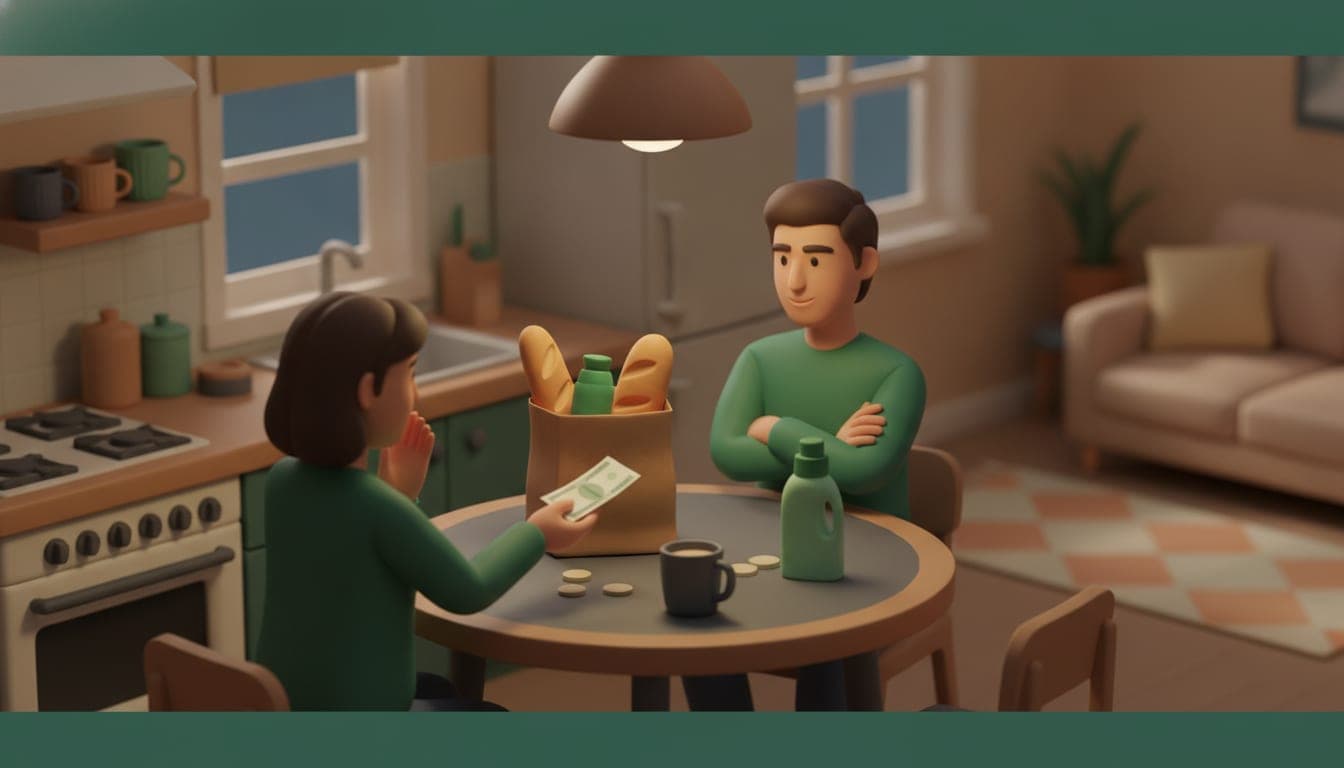
Here is how to split bills with roommates in six moves: list the shared items, set a rule for each one, record who paid for what, work out each balance (paid minus share), reduce the debts to the fewest payments, and check that the balances add up to zero. For a three-person apartment, that's about fifteen minutes of work a month.
Roommate bill splitting is a settlement in which every shared cost is divided by a rule agreed in advance, and the difference between what someone paid and their share becomes a debt or a credit. The example below follows one apartment through one month, with real amounts in dinars.
Key takeaways
- Before the first entry, decide what is shared: rent, electricity, utilities, internet and household supplies are; personal food and a personal phone plan are not.
- Split the rent by the size and quality of each room, and everything else into equal parts, unless usage clearly differs.
- After every settlement, the balances must add up to exactly zero; if they don't, look for a bill entered twice or a leftover dinar that wasn't assigned.
- Don't pay everyone back one by one: route the debts to whoever paid upfront, so the total number of payments never exceeds the number of roommates minus one.
Step 1: What do roommates share, and what stays personal?
Shared costs are the ones that serve everyone and can't easily be measured per person. Personal food, a personal phone bill and streaming subscriptions stay out of the settlement unless everyone has agreed otherwise.
Write the list once and paste it into the group chat.
| Item | Shared? | Reason |
|---|---|---|
| Rent | Yes | Paid once, to the landlord |
| Electricity | Yes | One meter for the whole apartment |
| Utilities | Yes | One bill for the apartment |
| Internet | Yes | One contract, everyone uses it |
| Detergent, toilet paper, cooking oil | Yes | Used by everyone |
| Food each person buys for themselves | No | Personal consumption |
| Personal mobile plan and subscriptions | No | Tied to one person |
In our example, the apartment is for three, and roommate A is on the lease, so A pays the rent, electricity and utilities upfront. Roommate B pays for the internet, and roommate C buys the shared groceries.
Step 2: Which splitting rule goes with which item?
Split the rent by room and everything else equally. Rent is the item that differs most from room to room: a bigger room or one with a balcony justifies a bigger share. Everything else is used about equally by each person, so an equal split is the simplest.
In the example, the rent is 72,000 RSD (the example amounts in this article are in Serbian dinars), and the rooms split it 40%, 32% and 28%:
- roommate A (largest room): 28,800 RSD
- roommate B: 23,040 RSD
- roommate C: 20,160 RSD
The total is exactly 72,000 RSD. If someone feels shortchanged, negotiate the percentages before the first month, not in the middle of a settlement. If someone uses much more electricity (works from home, has an extra appliance), agree on a separate percentage for that item, but only with the consent of all three.
Step 3: How do you record who paid for what?
Enter every cost at the moment it's paid, with four details: description, amount, who paid and who shares it. The person who paid enters the bill, because they have the bill or receipt at hand. Putting it off until the end of the month can mean a lost electricity bill or nobody remembering who bought the cooking oil.
| Cost | Amount (RSD) | Paid by | Split |
|---|---|---|---|
| Rent | 72,000 | A | By room (40/32/28) |
| Electricity | 9,900 | A | Equal |
| Utilities | 6,300 | A | Equal |
| Internet | 3,000 | B | Equal |
| Shared groceries | 5,700 | C | Equal |
For groceries, photograph the receipt or scan it, then remove from the list anything bought for just one roommate. That way, nobody else's chocolate ends up in the shared total. Roommates don't have to install anything: they just open the sharing link in a browser and see what has been entered.
Step 4: How do you work out each roommate's balance?
A roommate's balance is what they paid minus their total share: a positive number means the others owe them, a negative one means they owe. The math is plain addition and subtraction, not an AI estimate, so the same entries always give the same result.
The shared costs come to 9,900 + 6,300 + 3,000 + 5,700 = 24,900 RSD, which is 8,300 RSD per person.
| Roommate | Paid | Share (rent + 8,300) | Balance |
|---|---|---|---|
| A | 88,200 | 37,100 | +51,100 |
| B | 3,000 | 31,340 | −28,340 |
| C | 5,700 | 28,460 | −22,760 |
Roommate A paid upfront. So the other two owe A a total of 51,100 RSD.
Step 5: How do you reduce the debts to the fewest payments?
You reduce the debts by having each roommate with a negative balance pay directly to the one with a positive balance, so the total number of payments never exceeds the number of roommates minus one. In our apartment that's exactly two payments: B sends A 28,340 RSD, and C sends A 22,760 RSD. Nobody pays money back to someone they don't owe anything.
With three people and one creditor, this is easy to work out in your head. With five roommates and several payments crossing each other, reducing by hand quickly turns into a mess, so leave that part to an app. Split The Bill calculates it automatically and shows only the final payments.
The person who is owed can send a payment link instead of chasing people with messages. How it looks when the claim is only the rent is explained in the article on how to collect rent from a roommate.
Step 6: How do you close the month and check that the total is zero?
The month is closed when all three balances add up to exactly 0 and both payments are marked as made. In the example: +51,100 − 28,340 − 22,760 = 0. That total is your check, because every dinar someone paid must be someone's share.
If the total isn't zero, check in this order:
- Whether the same bill was entered twice (e.g. electricity entered both from the paper bill and from the banking app).
- Whether the number of participants was marked wrong on some item.
- Whether a leftover dinar was left unassigned. A 10,000 RSD bill split three ways gives 3,333, 3,333 and 3,334; the extra dinar always goes to one person, and next time to another.
Next month starts from a zero balance. Recurring costs, like rent and internet, can be set to appear on their own, with a reminder.
What most often breaks a roommate settlement?
Cash payments without a receipt and putting off the settlement can break it, and the fix is a rule agreed in advance.
- Cash with no trace. If someone paid in cash, photograph the receipt the same day. Without a photo, nobody knows the next day whether the oil cost 400 or 600 dinars.
- Waiting for someone to ask. For example, a creditor who stays quiet for two months and then submits a 40,000 RSD bill can cause a bigger problem than one who closes the settlement every month.
When a couple lives in an apartment with roommates, the settlement follows the same steps: the couple counts as two participants, and you split the rent and the other items using the rules from step 2. If it's just the two of you, with no third roommate, a simpler way to split expenses as a couple is enough.
What if roommates have dinner together abroad?
When roommates travel together, the same question comes back: who ordered what.
Example: three roommates on a weekend in an unfamiliar city sit down in a restaurant with a menu in a language none of them speaks.
- One of them photographs the menu in the app and reads it in a language they understand.
- They send the link to the group chat.
- Everyone marks the dishes they want and immediately sees their own total.
- At the end, they show the waiter the order list in the local language instead of pointing a finger at the menu.
The page on how to order from a menu you can't read covers this flow from the menu photo to the order list you show the waiter in the local language.
Frequently asked questions
How do you split costs when someone moves in or out mid-month?
Calculate that roommate's share in proportion to the number of days they actually lived in the apartment. The remaining roommates split the difference among themselves. Agree on this before the move-in, including what happens with the deposit, because the deposit isn't part of the monthly settlement.
How often should you do a settlement?
Once a month, right after the last bill arrives.
Where do you start this month?
Take last month's bills and enter them following the table from step 3, then see whether the balance comes out to zero. If it does, agree on the rules and do the same from next month on. For this, Split The Bill takes the entered costs and calculates the final payments.
Try Split The Bill — free
10 receipt-scanned bills/month, recurring expenses, multi-currency, and settle-up via Venmo / PayPal / Revolut.
Create a free accountRelated posts

Collecting Rent by Sending a Request Link: Bill Your Roommates in 10 Minutes
How to collect rent by sending a request link, in 5 steps, using 90,000 yen split three ways. Your roommates need no app and no sign-up: they open the link, see their share, and pay.
- Rent
- Roommates
- Utilities
Use a Roommate Bill Splitting App for Uneven Utility Bills
How to split swinging electric, water and grocery bills line by line from receipt photos in a roommate bill splitting app.
- Roommates
- Utilities
- App
How to Calculate Sharehouse Rent Apportionment as an Expense | Determining Ratios Explained
A guide for freelancers and sole proprietors on calculating rent apportionment in a sharehouse. Learn formulas, bookkeeping, and audit-ready records for both private room and group leases.
- Rent
- Expenses
- Splitting