
Recipe
Budget shared household spending — by the category that actually creeps
Set a monthly limit for groceries, utilities, and household supplies. Every bill you tag to that category counts against the limit automatically — the bar turns red when you go over, so you see the overspend before month-end, not after.
Last reviewed: January 2026
Most household budgets fail the same way: nobody is watching the category total. One person does the grocery run, another pays the electric bill, a third fronts the cleaning supplies — each expense looks reasonable on its own, and nobody notices groceries drifted from $400 to $650 a month. Split The Bill's budgets feature makes the category the unit of accountability. You set a monthly limit per category, tag every shared bill to a category, and the app shows a live progress bar for the current calendar month. It's a soft cap — going over just colours the bar red, it never blocks anything — so it nudges rather than nags. This guide walks a typical shared-household setup, with real numbers.
Step-by-step
- 1
Decide which categories actually matter
Before touching the app, look at where your shared money really goes. The category list is 7 buckets total (restaurant, groceries, transport, lodging, entertainment, shopping, other) — for most households only two or three of those matter: groceries, shopping (household supplies), and maybe restaurant for shared takeout nights. Utility bills don't have a dedicated category — tag them "shopping" or "other", whichever you'll remember consistently.
Don't budget every category the app offers. A budget you have to think about for seven lines is a budget nobody reviews. Pick the two or three that (a) are large and (b) drift month to month — those are the ones worth a limit. Fixed costs like rent don't need a budget line; they don't drift.
- 2
Set your first budget on /budgets
Open `/budgets` and tap Add budget. The form is three fields:
- Category: pick from the list (restaurant, groceries, transport, lodging, entertainment, shopping, other) - Currency: the currency this budget is tracked in (e.g. USD) - Monthly limit: a positive number, e.g. 500 for groceries
Save. That's one budget. The limit is *per calendar month* — it resets on the 1st automatically, no action needed.
One thing to know: a budget is keyed on the category + currency pair. Saving a groceries/USD budget again just updates the limit — it doesn't create a duplicate. So there's no way to accidentally end up with two grocery budgets fighting each other.
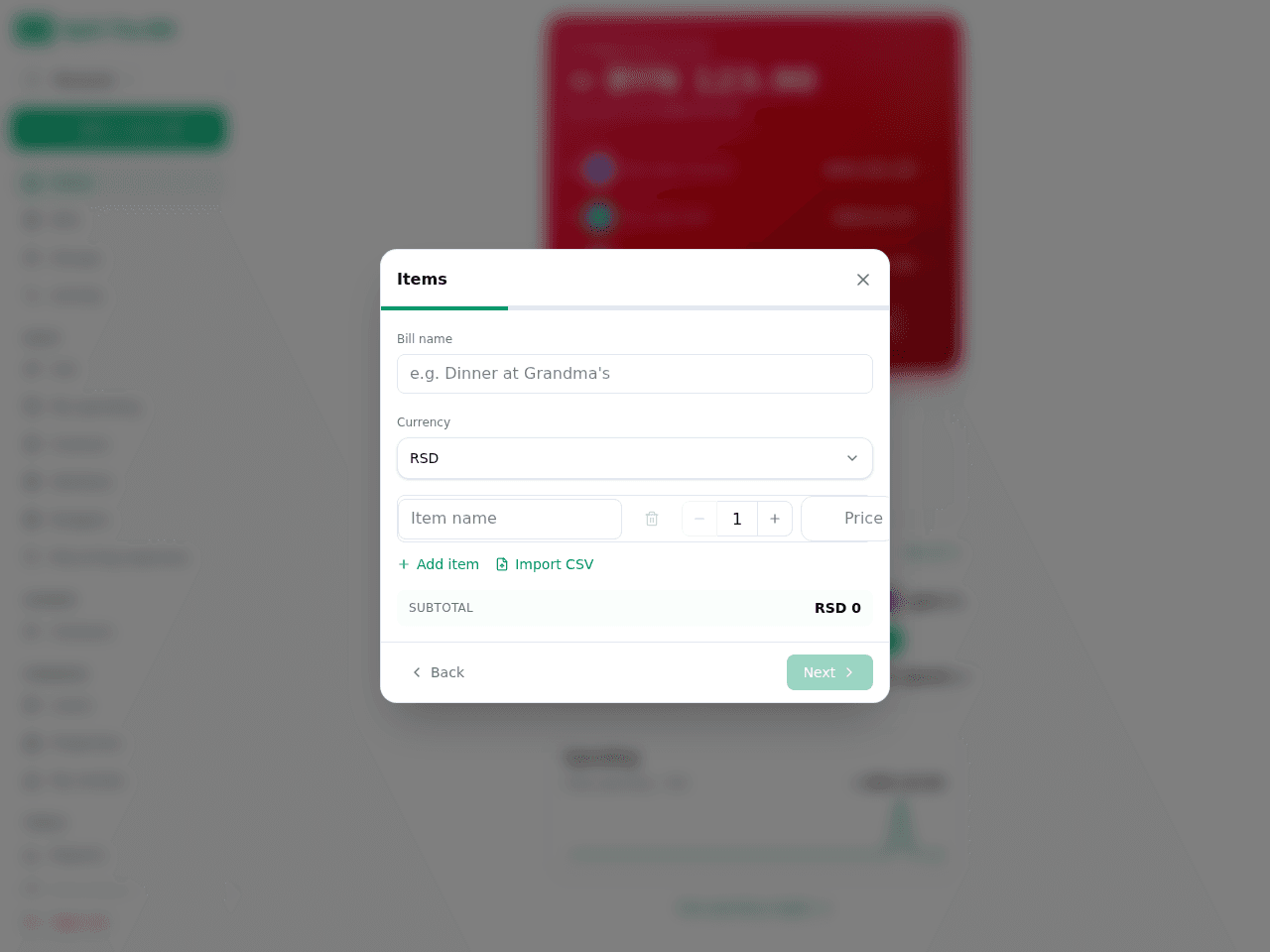
Three fields per budget: category, currency, monthly limit. - 3
Add the two or three budgets you actually need
Repeat for each category you chose in step 1. A realistic three-roommate household might set:
- Groceries: $500/month - Utilities: $260/month (electric + water + internet averaged) - Household supplies (shopping): $90/month
That's the whole budget. Three lines, each with a bar that fills as real bills land against it. You're not trying to budget every dollar — you're watching the three categories that historically creep.
- 4
Tag every shared bill to its category
This is the step that makes the budget honest. When you create a bill — a Costco run, the electric bill, a pack of paper towels — set its category on the bill. Budgets only count bills that match the budget's category *and* currency, in the *current calendar month*.
So a $185 grocery bill dated this month lands against the groceries budget. A grocery bill dated 45 days ago does not — it belongs to last month's window and last month's budget already closed. This is deliberate: each month's bar reflects only that month's spending, so a bad January doesn't haunt February.
If you forget to tag a bill, it simply won't count — the fix is to open the bill and set its category, then the budget picks it up on the next refresh.
- 5
Watch the bars during the month, not just at the end
The value of a live bar is that it warns you *before* the overspend. On the groceries budget at $500, once real bills add up to $450 the bar sits at 90% and the number reads in muted grey. Cross $500 and the bar turns red with an over-limit percentage (say 118% at $590 spent).
The cap is soft — nothing is blocked, no bill is rejected. It's a signal, not a gate. When the grocery bar hits red on the 20th, that's the moment for the "let's slow down on the takeout for the rest of the month" conversation — while it can still change the outcome.
- 6
Do a 60-second month-end review
At the start of each new month the bars reset to zero. Before they do, glance at where each one landed: groceries came in at $470 of $500 (fine), utilities at $310 of $260 (over — the summer AC bill hit), supplies at $60 of $90 (under).
That 60-second look is the whole point. "Utilities ran over by $50 this month" is a number everyone can see, not a vague argument. If a category runs over three months straight, that's the signal to raise its limit to something realistic — a budget you blow every month isn't a budget, it's a wish. Update the limit on `/budgets` and the new figure applies from that month forward.
Why a category budget beats "just watch the total"
Watching a single household total tells you *that* you overspent but not *where*. By the time the total looks wrong, the month is over and there's nothing to do about it.
A per-category budget is diagnostic. When groceries is at 95% on the 18th but utilities is at 40%, you know exactly which behaviour to change — you don't cut back on everything indiscriminately, you slow down on the one category that's running hot. That's the difference between a budget that changes what you do and one you read at month-end and sigh at.
It also removes the blame dynamic. You don't budget "Alice's spending" versus "Bob's spending" — you budget groceries, and whoever paid for groceries this month counts against the shared limit. The category is the unit, not the person, which keeps the review about numbers instead of about who overspent.
Picking limits that hold
The most common budgeting mistake is setting aspirational limits — the number you *wish* you spent — then blowing through them every month until you stop looking.
Set limits from your own history, not from a blog post's idea of what a household "should" spend. Look at what groceries actually cost last month and the month before. If it was $480 and $510, set the budget at $500, not $400. A $400 limit you exceed every single month teaches you to ignore the bar. A $500 limit you occasionally brush against keeps the bar meaningful.
Then adjust with reality. If a category runs over three months running, the limit is wrong, not your spending — raise it. If it runs 30% under every month, tighten it so the bar means something again. A budget is a living number, re-tuned every quarter or so, not a resolution set once in January.
How the current-month window works
Budgets always measure the current calendar month. On the 1st every bar starts at zero regardless of how last month ended — there is no rollover, no carried-over overspend. This is intentional: each month gets a clean slate so the bar reflects "how are we doing *this* month", which is the only question you can still act on.
Only bills dated inside the current month count. A bill you backdate to last month, or a recurring bill that generated in a prior month, won't appear in this month's progress. And because a budget matches on currency too, a groceries budget in USD tracks USD grocery bills only — if part of your household spends in EUR, set a second groceries/EUR budget for that slice. The two are tracked independently and never mixed at a fabricated exchange rate.
When a budget is the wrong tool
Budgets answer "are we spending what we agreed to, by category". They do not track who owes whom — that's what group balances and settle-up are for. If your question is "did Bob pay me back for the electric bill", look at the bill's shares and the group balance, not the utilities budget. The two features are complementary: budgets watch the total, balances watch the debts.
Budgets are also monthly by design. For a one-off future cost you want to plan and save toward — a security deposit, a shared appliance, a trip — use the Planner (`/plans`) instead, which is a forward-looking dated-payment tool rather than a recurring monthly cap. And for recurring fixed bills that don't drift (rent, a fixed-price subscription), a recurring template that auto-creates the bill each month is a better fit than a budget line you'd never review.
Frequently asked questions
Is the budgets feature free?▾
Yes — per-category monthly budgets are in the free tier. There's no separate budgeting add-on. The only meaningful free-tier limit anywhere is the 10 receipt-scanned bills per 30 days for AI OCR; setting and reviewing budgets doesn't touch that quota at all.
Does going over the budget block me from adding a bill?▾
No. It's a soft cap. Crossing the limit just turns the progress bar red and shows an over-limit percentage — it never rejects a bill or blocks any spending. The bar is a signal to have a conversation, not a gate.
How does the app know a bill counts toward a budget?▾
A bill counts when its category and currency match the budget's, and it's dated in the current calendar month. So a $185 groceries bill in USD dated this month lands against a groceries/USD budget. If you forget to set a bill's category, it won't count — open the bill, set the category, and it's picked up on the next refresh.
Does last month's overspend carry into this month?▾
No. Every budget bar resets to zero on the 1st of the month. There's no rollover — each month is a clean slate measuring only that month's bills. This keeps the bar focused on the spending you can still change.
Can I budget in more than one currency?▾
Yes. A budget is keyed on category plus currency, so you can run a groceries budget in USD and a separate groceries budget in EUR side by side. They track independently — the app never mixes currencies at an invented exchange rate to force them into one bar.
How many categories should I actually budget?▾
For most households, two or three — the categories that are both large and drift month to month, typically groceries, transport, and shopping. Budgeting all seven categories creates a screen nobody reviews. Fewer, well-chosen limits get looked at; a wall of bars gets ignored.
What if a category is over budget every single month?▾
Then the limit is wrong, not your spending — raise it to a realistic number based on your actual last-few-months history. A limit you exceed every month trains you to ignore the bar. Update it on /budgets and the new figure applies from that month forward.
Free tier covers most recipes. Pro is 100 receipts every 30 days + private invite links.


