
Recipe
Split a vacation rental with a group — deposit, rooms, and all
Pool the booking deposit into a shared kitty up front, then split the house fairly — the couple in the master suite pays a bit more, the person on the sofa bed pays a bit less.
Last reviewed: January 2026
Group house rentals are where "we'll just split it evenly" quietly falls apart. One person fronts a $1,200 deposit six weeks before the trip, the rooms are wildly different (a master suite with an ensuite vs. a bunk in the loft), and by check-out nobody remembers who already chipped in for the deposit. This recipe uses two features built for exactly this: a shared trip kitty to collect the deposit and running costs up front, and an adjustment split so the house total is fair to the room you actually slept in — without doing the math by hand. Example throughout: an 8-person beach house at $2,400 for the week.
Step-by-step
- 1
Create a group for the house
Tap New group → name it after the rental ("Outer Banks House — June"). Add all eight people by email; each gets a one-click invite link and lands in the group after signing up.
Set the group's default currency to whatever the booking is in (USD for a US rental, EUR for a place in Europe). Everything below — the kitty, the split, the settle-up — inherits this currency, so pick it once here and forget about it.
If one or two people in the group refuse to install anything, invite them anyway. Every bill you post can be shared with a public link, so they can see their share and pay without an account.
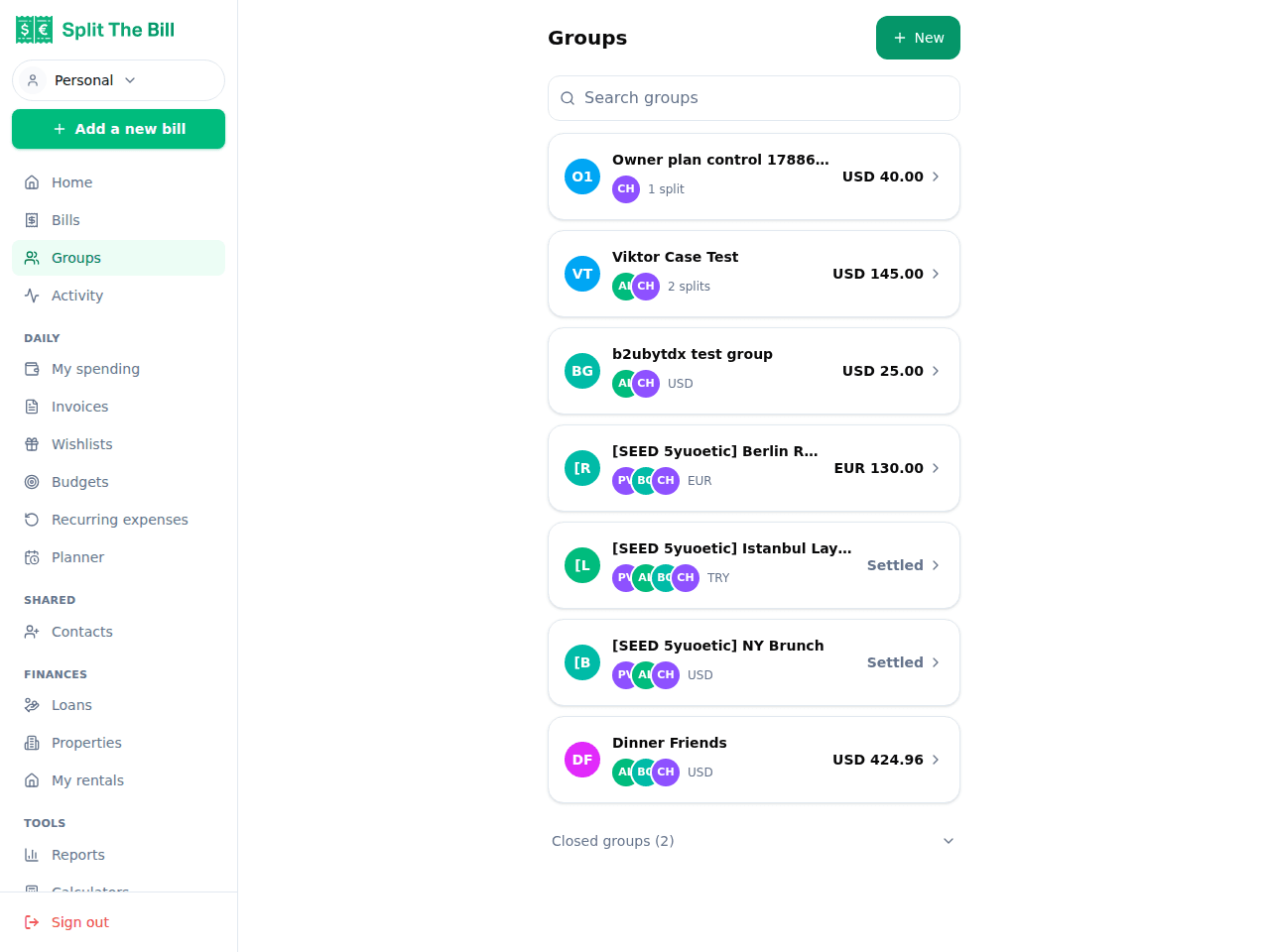
The house group, once everyone accepts the invite. 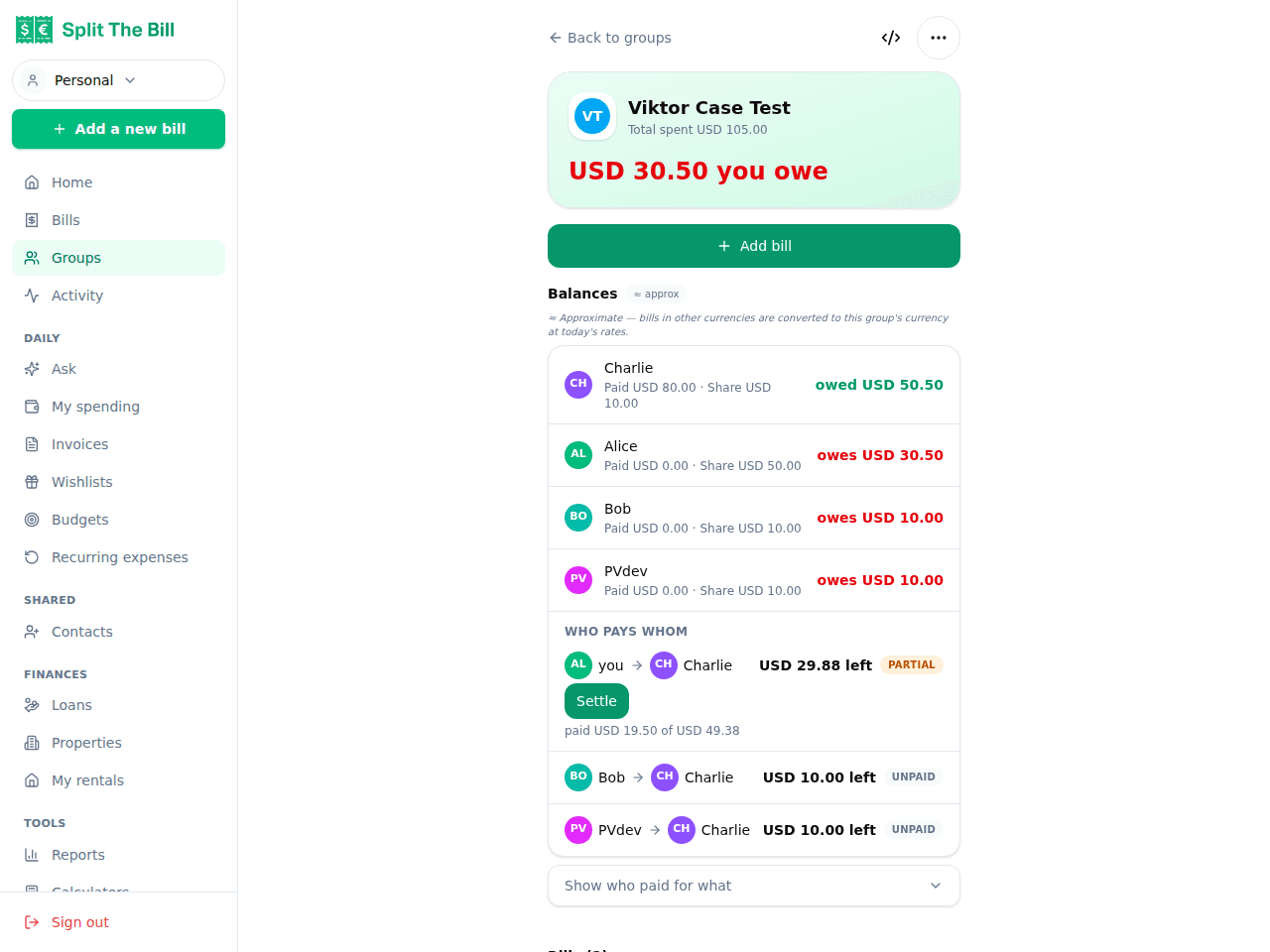
Every bill and kitty contribution rolls into one running balances view. - 2
Start a trip kitty and collect the deposit
Most rentals want a deposit weeks before check-in, and one person almost always fronts it. Instead of that person quietly carrying the risk, open the group and tap Start kitty → create it in the group currency.
Say the booking needs a $1,200 deposit split eight ways — that's $150 each. As each person pays you back, log it: tap Contribute → enter their amount ($150) and a note ("deposit share"). The kitty shows a running Pool total and every contribution, so at a glance you can see who's chipped in and who still owes.
The kitty is a shared, transparent pot — everyone in the group sees the same contributions list, so there's no "did I already pay you for the deposit?" three weeks later.
Log each deposit contribution — the pool total updates live. - 3
Add the rental as a bill when the final total lands
When the balance-due invoice arrives from the host, post it as a bill. Tap New Bill → enter the house total (e.g. $2,400 for the week) in the group currency, set the payer to whoever's card the booking went on, and pick a category like *lodging* so it shows up cleanly in the trip's spending breakdown later.
If the deposit you collected in the kitty already went toward this total, just enter the remaining balance due here — treat the kitty as the deposit ledger and the bill as the balance. Keep the two numbers straight and the group total stays honest.
- 4
Split the house by room with an adjustment split
Even splitting an $2,400 house eight ways is $300 a head — but that's not fair when the rooms are so different. Open the bill → Split this bill → choose the By adjustment method. It starts everyone at the equal share ($300) and lets you nudge each person up or down by a fixed amount. The nudges have to cancel out, so the house total always stays exactly $2,400.
A worked example for the beach house:
- Master suite couple (2 people): +$60 each — they get the big ensuite room. - Two standard doubles (4 people): $0 adjustment — they pay the plain $300 share. - Loft bunks (2 people): −$60 each — smallest space, so they pay less.
The positives (+$60 × 2 = +$120) exactly offset the negatives (−$60 × 2 = −$120), so the suite couple pay $360 each, the loft pair $240 each, everyone else $300. Sum: still $2,400. Nobody argues, because the logic is right there and the math is done for you.
- 5
Add shared trip costs against the same group
Groceries for the house, the cleaning fee, the rented kayaks, the one big group dinner — post each as its own bill in the same group. Split the ones everyone shared equally; use By adjustment again for anything where one sub-group used more (e.g. the two people who booked the fishing charter get a +adjustment, everyone else 0).
You can also draw these from the kitty if you pre-funded it: log the house grocery run as a contribution *out* the same way you logged deposits in, and keep the pool as your single running "house fund" number. Either way, every cost lives under one group with one rolled-up balance.
- 6
Settle up at the end — kitty and bills together
On the last morning, open the group to see the net position for each person across the deposit kitty and every bill. Because the kitty already captured who pre-paid the deposit, the settle-up reflects real outstanding balances — not "everyone owes $300" when half the group already paid their deposit share.
Each non-zero row has a Pay button that opens the right app (Venmo, PayPal, Revolut) with the amount prefilled; for European bank transfers, the SEPA / IBAN option shows a QR the recipient scans in their bank app. One tap per person and the house is squared away before anyone leaves for the airport.
When to use the kitty vs. just posting bills
The two features solve different halves of a group rental, and the trick is knowing which to reach for.
**Use the kitty for money collected *before* costs are known.** The deposit is the classic case: you need $1,200 in hand six weeks out, long before the final house total or the grocery bill exists. The kitty is a shared, transparent pot for exactly that — members contribute, the pool total is visible to everyone, and nobody has to trust one person's memory of who paid.
Use bills + splits for actual costs. The house total, the cleaning fee, the group dinner — these are real expenses with a payer and a fair way to divide them. That's what the split methods are for.
In practice you run both at once: the kitty tracks the pre-trip float, the bills track the spend, and the group's running balance nets them together at settle-up. Note the current kitty is contributions-only — a clean shared ledger of who put in what, not an automatic auto-deduct wallet — so you'll still post real costs as bills.
Why the adjustment split is the right tool for uneven rooms
People reach for percentages or exact amounts when rooms differ, and both are more painful than they need to be.
Percentages drift off the total. Assign 15% / 12.5% / 10% to eight people and getting them to sum to exactly 100% is fiddly; round wrong and the house doesn't add up.
Exact amounts mean doing all the math yourself. You're back to a calculator, and if the host changes the total by $50 you redo every number.
The adjustment split keeps the equal share as the anchor and only asks the one question that actually matters: how much more or less should this room pay? A +$60 / −$60 nudge is intuitive, the app guarantees the adjustments cancel so the total is always exact, and if the house total changes you only touch the base — the room nudges stay valid. It's the fairness of custom amounts with the safety of an equal split.
Common pitfalls and how to avoid them
Double-counting the deposit. If the deposit you collected in the kitty is applied by the host toward the final total, don't also split the full house total as if the deposit is still outstanding. Either post the bill for the *remaining balance* only, or keep the kitty purely as the deposit ledger and reconcile it at settle-up. Pick one and be consistent.
Adjustments that don't cancel out. If your +adjustments and −adjustments don't offset, the split won't total the house price. The app flags this — read the check and rebalance so positives equal negatives.
Forgetting someone who joins late. Add a friend who books in after you've set the split, and they won't auto-join the existing bill's split. Re-open the bill's split, add them, and re-balance the room adjustments.
Treating a variable cost as fixed. Cleaning fees and utility surcharges sometimes land after check-out. Post them as their own bill when the real number arrives rather than baking a guess into the house total.
When a different approach fits better
For a two-couple rental where everyone genuinely used the place equally, skip the adjustments — an equal split and a single settle-up is less overhead than fine-tuning room prices.
For a rental where one person books everything and just wants reimbursing, you may not need a kitty at all: post the house as one bill, split it, and let the Pay buttons handle it.
For mixed-currency groups (a friend flying in who thinks in USD while the house is priced in EUR), lean on multi-currency — each bill stays in its native currency and settle-up reconciles when a peer pays in another one. That's in the free tier here, where several apps paywall it.
Frequently asked questions
Is splitting a vacation rental free?▾
Yes. Groups, the trip kitty, adjustment splits, multi-currency, and settle-up links are all in the free tier. The main metered thing is AI receipt scanning (10 scans per 30 days on free) — and you don't need OCR to post a house total or log a kitty contribution, so a rental split costs nothing.
How does the trip kitty work exactly?▾
You start a kitty in the group currency, and members log contributions with an amount and optional note (e.g. "deposit share $150"). Everyone in the group sees the running Pool total and the full contributions list. It's a transparent shared ledger — in its current version it tracks contributions rather than auto-deducting expenses, so you still post real costs as bills and net everything at settle-up.
What is an adjustment split and when should I use it?▾
It starts everyone at the equal share, then lets you nudge each person up or down by a fixed amount — perfect for a house where rooms differ. The nudges must cancel out, so the total always stays exact. For an $2,400 house split 8 ways, the master-suite couple might be +$60 each and the loft pair −$60 each: the suite pays $360, the loft $240, everyone else $300, and it still sums to $2,400.
Can the person who fronted the deposit get paid back fairly?▾
Yes — that's the point of the kitty. As each housemate pays their deposit share, you log it as a contribution, so the pool shows exactly who has and hasn't reimbursed the person who fronted the money. At settle-up, those contributions net against the bills so nobody double-pays.
How many people can I split a rental with?▾
There's no small-group cap — split a house with 8, 12, or a whole reunion. The adjustment split scales to as many people as are on the bill, and the group balances roll everyone up into one view. Large groups are exactly where the kitty and adjustment split earn their keep.
Do the housemates who don't use the app still work in this?▾
Yes. Send them a public share link to any bill — they see the items, their share, and a Pay button, no account or install needed. They can't log their own kitty contributions, so you'd record those on their behalf, but they can always pay their share directly.
What if the final house total changes after I've set the split?▾
Edit the bill's amount and the adjustment split re-derives — the equal base recalculates and your per-room nudges stay valid because they're fixed amounts that still cancel out. You don't redo everyone's number by hand; you change the one total and the app handles the rest.
Free tier covers most recipes. Pro is 100 receipts every 30 days + private invite links.


