How to Split a Drinking Party Bill: Rounding Up and Handling the Leftover
How to split a drinking party bill with just a calculator. For 43,700 yen among 7 people, rounding up to the nearest 100 yen leaves 400 yen extra, while rounding down leaves you 300 yen short. Includ…
Split a receipt in seconds, no sign-up needed.
Scan one free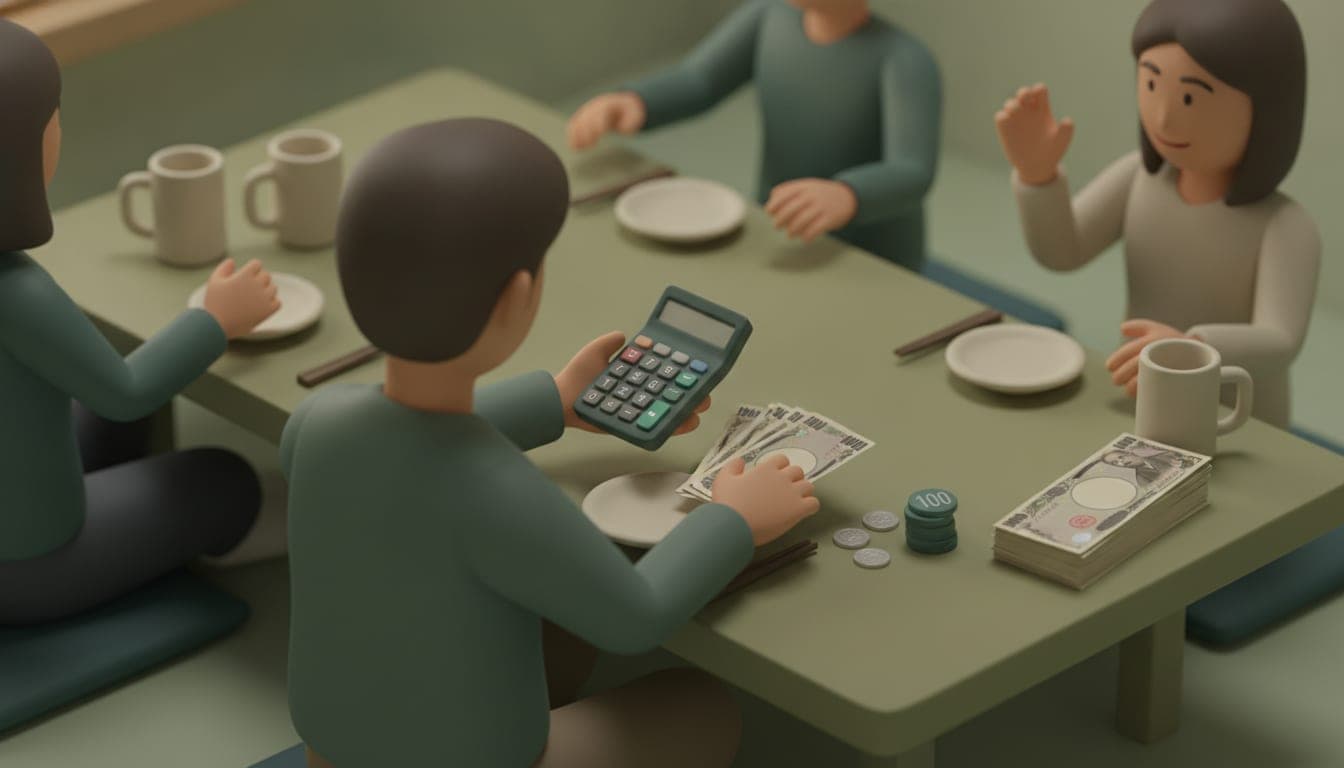
Splitting a drinking party bill doesn't end at "total ÷ headcount." Divide a total of 43,700 yen (all example amounts in this article are in Japanese yen) among 7 people and you get 6,242.857… yen each; round up to the nearest 100 yen and you have 400 yen left over, round down and you are 300 yen short.
An even split means dividing the bill total into equal shares across everyone who attended. Whether you round the remainder up or down changes how much the organizer ends up holding.
Key takeaways
- Before dividing, check the "actual amount you pay, tax included" after coupons or points are applied, and always count the organizer in the headcount. If you get this wrong, every calculation after it is off.
- Rounding up to the nearest 100 yen is the default. For 43,700 yen and 7 people, that is 6,300 yen each, with 400 yen left over. Rounding down leaves you 300 yen short, and the organizer ends up covering it.
- Before you start collecting, decide where the leftover goes (the organizer's time and trouble, the after-party, or a reduction of the organizer's own share). The difference is "per-person amount × headcount − total."
How long does it take to split a drinking party bill?
With a calculator, an experienced organizer can finish in about 5 minutes. You need only three numbers: the total including tax, the headcount including the organizer, and the unit you round to (100 yen in this article's example).
The flow has three stages: divide the total by the headcount, round the remainder, then multiply the rounded amount by the headcount and compare it with the total. That last comparison shows plainly whether you have a surplus or a shortfall.
This assumes everyone ate and drank about the same and stayed about the same length of time. If drinking and orders vary a lot, switching to a split by item will cause fewer arguments later.
Step 1: What is the total on the receipt, including tax and service charge?
What you check before dividing is the final amount actually paid. Specifically, use the "total due," which includes consumption tax, service charge, the appetizer charge (otoshi) and any table charge, after subtracting coupons and discounts.
At a place that lists tax-inclusive prices, the total field is your total as it stands. At a place that lists prices before tax, use the amount after tax is added, not the subtotal. Asking the staff before you pay, "What is the total with tax?", helps you avoid misreading it.
In this article's example, the total is 43,700 yen. Start by leaving just this number in your notepad or on your calculator screen.
Step 2: How much is that per person when you divide the total by the headcount?
The per-person amount doesn't divide evenly, so you can't charge it as it is. Leave it on the calculator as the value before rounding.
Count the headcount including the organizer. Check the number of "attending" on the RSVP list once more right before the bill is settled. If someone dropped out on the day or joined partway through, the headcount changes accordingly.
Checking is easy: multiply 6,242.857… by 7 and you get back to 43,700 yen. If you don't, either the total or the headcount you entered is wrong.
Step 3: Should you round the remainder up or down?
Rounding up to the nearest 100 yen gives 6,300 yen each, 44,100 yen in total, so you have 400 yen left over. Rounding down gives 6,200 yen each, 43,400 yen in total, so you are 300 yen short.
| Rounding method | Per person | Total for 7 people | Difference from the total |
|---|---|---|---|
| Round up to the nearest yen | 6,243 yen | 43,701 yen | +1 yen |
| Round up to the nearest 10 yen | 6,250 yen | 43,750 yen | +50 yen |
| Round up to the nearest 100 yen | 6,300 yen | 44,100 yen | +400 yen |
| Round down to the nearest 100 yen | 6,200 yen | 43,400 yen | −300 yen |
| Round up to the nearest 500 yen | 6,500 yen | 45,500 yen | +1,800 yen |
The default is rounding up to the nearest 100 yen. There are two reasons. You never worry about coming up short at the register, and everyone can pay with thousand-yen bills and 100-yen coins, so there's less change to prepare.
Even when rounding up, each person pays at most 99 yen extra.
Rounding to 500 yen makes each amount easy to remember, but in this example the leftover swells to 1,800 yen and needs explaining. Choose rounding down only when it's understood that the organizer will cover the shortfall.
Step 4: Who covers the leftover or the shortfall?
The difference comes from "per-person amount × headcount − total." If it's positive, you have a surplus; if negative, a shortfall.
When there is a surplus, choose how to use it from these three options:
- Treat it as the organizer's compensation for the effort. The 400 yen left over goes straight to the organizer.
- Carry it over to the after-party or the next gathering's fee. Tell everyone the amount and treat it as a "carryover."
- Reduce the organizer's own payment.
When there is a shortfall, the organizer covers the 300 yen, or you switch the collection to rounding up. You could also collect the shortfall from each person at the end, but the hassle of contacting everyone again for a few hundred yen tends to outweigh it.
If someone later asks, "What happened to the leftover?", the organizer is stuck trying to explain.
What are the typical mistakes that throw off the calculation?
The three that most often throw things off are miscounting the headcount, leaving out the organizer's own row, and counting tax twice. None of them is a problem with the formula; they are problems with the numbers you enter.
| Mistake | What happens (for 43,700 yen and 7 people) | How to prevent it |
|---|---|---|
| Counting 6 people | It comes to about 7,283 yen each, so you collect about 1,040 yen more than the correct 6,243 yen | Recount the headcount, including the organizer |
| No row for the organizer | Even collecting 6,300 yen from 6 people gives 37,800 yen, which is 5,900 yen short of the bill | Put the organizer in the first row of the collection sheet |
| Applying tax twice (assuming a 10% tax rate) | 43,700 yen × 1.1 = 48,070 yen, about 6,867 yen each, about 620 yen too much | Check whether the receipt total already includes tax |
Worked example: a 43,700 yen bill for 7 people, who pays how much?
Take a sales department welcome-and-farewell party (7 people including the organizer, one receipt). The result: 6 people pay 6,300 yen and the organizer pays 5,900 yen, leaving no cash surplus or shortfall.
- Check the tax-inclusive total on the receipt: 43,700 yen
- Divide by the headcount including the organizer: 43,700 ÷ 7 = 6,242.857… yen
- Round up to the nearest 100 yen: 6,300 yen
- Multiply by the headcount to verify: 6,300 × 7 = 44,100 yen, so 400 yen is left over
- Treat the 400 yen leftover as the organizer's compensation and set the organizer's payment at 5,900 yen: 6,300 × 6 + 5,900 = 43,700 yen
The message you send to participants only needs to make two things clear: the amount and how to pay.
Tonight's fee is 6,300 yen per person. To avoid making change, please pay with thousand-yen bills and 100-yen coins.
Frequently asked questions
Can people who don't drink or who leave early pay the same amount?
If the difference is large, decide on a separate amount before collecting and announce it. For example, if 2 people pay a flat 3,000 yen, subtract 6,000 yen from 43,700 yen, which leaves 37,700 yen, and divide that among the other 5, so each pays 7,540 yen. Fixed amounts tend to cause arguments if raised after the fact, so mention them in the invitation.
If there's an after-party, can I calculate the bills together?
Calculate them separately. If some people attend only the first part, the headcounts differ, and combining the bills would make those who skip the after-party pay for it too.
What if someone doesn't have cash on the day?
The organizer covers it for now, and you send the amount and the payment deadline once, in the same message. Even for a few hundred yen, keeping one row in the collection sheet noting who covered how much means you won't forget to ask for it later.
How can you send the payment request with the least hassle?
The next step is to take the receipt from your most recent drinking party and work out, on a calculator, the total, the headcount, and the leftover after rounding up to the nearest 100 yen.
Split The Bill is a web app where you photograph the receipt to create the split and send a share link, and participants see their share in their browser without installing an app or signing up. The Free plan is free forever and needs no card registration.
Try Split The Bill — free
10 receipt-scanned bills/month, recurring expenses, multi-currency, and settle-up via Venmo / PayPal / Revolut.
Create a free accountRelated posts
Split Bill Online Calculator for Restaurant Checks: By Item, With Couvert
Use a split bill online calculator for a restaurant check: shared dish, couvert and 10% service, with a 5-person example that closes at €114.20.
- Splitting
- Bill
- Receipt
Bill Split and Tip Calculator: 4,800 RSD for 4 People
A bill split and tip calculator in one formula: a 4,800 RSD bill, a 10% tip and 4 people come to 1,320 RSD each, checked by multiplying back.
- Splitting
- Bill
- Deljenje
Split the Pub Tab by Item, Not Down the Middle
How to split a pub tab fairly: separate personal items, share snacks and tips proportionally. Example using a 12,000 RSD bill. Check the formula.
- Splitting
- Bill
- Deljenje