
Who owes who calculator: what you paid minus your share
A who owes who calculator in one line: the balance rule, a 4-friend example in a table, and the case of someone who skipped dinner. Check the math.
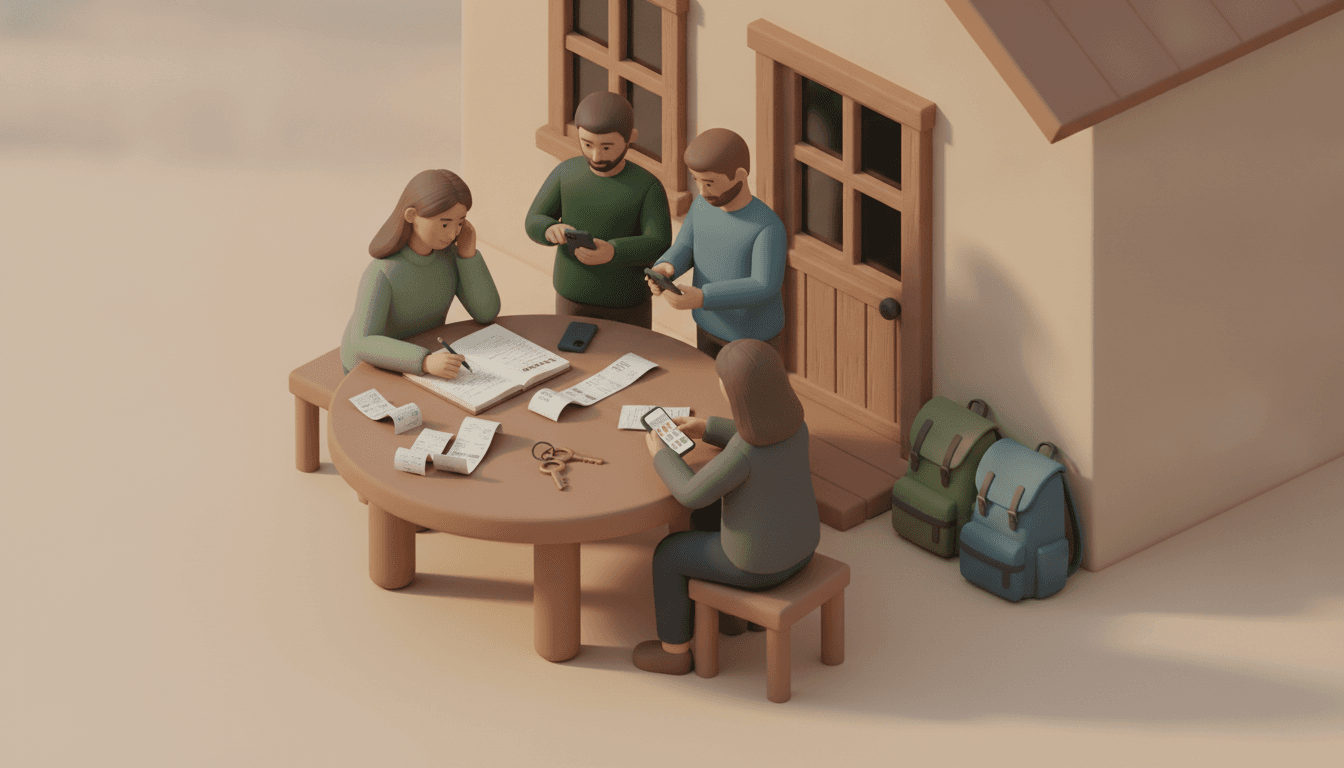
To work out who owes who, a who owes who calculator comes down to one sum per person: balance = what they paid − what they should have paid. A positive balance gets money back. A negative balance pays. No pivot tables, no hidden formulas.
Here's how it works in practice. Ana, Bruno, Carla and Diego went away for a weekend. Ana paid for the accommodation, Bruno for the groceries, Carla for the fuel and Diego for nothing. In the end, three Pix transfers to Ana settle everything. Below you'll find the full calculation, the case where someone sits out an expense, and the final check.
Key takeaways
- A group of N people can always clear its debts with at most N − 1 transfers, as long as you settle by net balance and not expense by expense.
- Reimbursing each expense separately, in the four-friend example, would take 9 Pix transfers; by net balance, 3 are enough.
- When someone doesn't consume an item, what changes is that person's share, never the amount they paid out.
- If the balances don't add up to exactly zero, there's a typo or a splitting error, and no Pix should go out until it's fixed.
What is the rule for working out who owes who?
The rule has two steps: first add up all the group's expenses and divide by the number of people to find the share; then subtract that share from the total each person paid out of their own pocket. The result is each person's net balance, and it already tells you who is owed and who owes.
In three lines:
- Group total = sum of all receipts and payment slips.
- Share = total ÷ number of people (for an equal split).
- Balance = what the person paid − share.
The logic is simple. Whoever paid more than their own share fronted money for the others and has a positive balance. Whoever paid less owes the difference. Whoever paid exactly their share is square and takes part in no transfers.
The most common mistake is skipping the balance step and trying to settle purchase by purchase: the groceries with Bruno, the fuel with Carla. It works, but it multiplies the Pix transfers and creates that situation where two people send money to each other on the same day.
How does the 4-friend example work, line by line?
Over the weekend, expenses came to R$ 1,000: R$ 600 for accommodation paid by Ana, R$ 240 for groceries by Bruno, R$ 160 for fuel by Carla and R$ 0 from Diego. Divided by four, each should have paid R$ 250. The table shows each person's balance.
| Person | Paid | Share | Balance (paid − share) | Status |
|---|---|---|---|---|
| Ana | R$ 600 | R$ 250 | +R$ 350 | Receives |
| Bruno | R$ 240 | R$ 250 | −R$ 10 | Pays |
| Carla | R$ 160 | R$ 250 | −R$ 90 | Pays |
| Diego | R$ 0 | R$ 250 | −R$ 250 | Pays |
| Total | R$ 1,000 | R$ 1,000 | R$ 0 |
Look at the last row. The Paid column and the Share column add up to the same amount, and the Balance column adds up to zero. That's no coincidence: it's proof the numbers balance (we come back to this in the checking section).
Another useful reading: Bruno paid for all the groceries and still owes R$ 10. It seems unfair until you look at the share. He spent R$ 240 when his part was R$ 250. This is the kind of thing that sparks arguments in the group when nobody shows the table.
Who pays how much to whom? From balances to Pix
To turn balances into transfers, pair the biggest debtor with the biggest creditor, transfer the smaller of the two amounts and repeat until everyone is at zero. In the example, only Ana has a positive balance, so the three debtors pay her directly: Diego R$ 250, Carla R$ 90 and Bruno R$ 10, adding up to the R$ 350 she fronted.
The step-by-step method, which works for a group of any size:
- List the creditors (positive balance) and the debtors (negative balance), from largest to smallest.
- Take the biggest debtor and the biggest creditor.
- The debtor transfers the smaller amount out of their debt and the other person's credit.
- Update both balances. Anyone at zero drops off the list.
- Go back to step 2 until everyone is at zero.
Each round clears at least one person, which is why the number of transfers never exceeds N − 1. With four people, that's at most three transfers via Pix, the Central Bank's instant payment system.
Compare that with settling expense by expense. The R$ 600 accommodation would require Bruno, Carla and Diego to send R$ 150 each to Ana. The groceries, R$ 60 from each of the other three to Bruno. The fuel, R$ 40 from each to Carla. That's 9 transfers, and Bruno would receive R$ 180 only to then pay back R$ 190. By balance, he sends R$ 10 and he's done.
A fair warning: the greedy method gives a good, simple result, but in large groups it isn't always the combination with the absolute fewest transfers possible. For typical trips and shared houses, the difference is usually one Pix, if there's any at all.
What if someone didn't share an expense, like Diego at dinner?
When someone sits out an expense, that expense is split only among those who took part, and each person's share becomes the sum of their parts of every expense they shared. This is where splitting the total equally breaks down: applied to the whole group, it charges people who weren't there.
A variation on the example: on Saturday, Ana, Bruno and Carla went out to dinner and Bruno paid R$ 180. Diego stayed at the hotel. The group total is now R$ 1,180, but dinner is split three ways (R$ 60 each), and the other R$ 1,000 is still split four ways (R$ 250 each).
| Person | Paid | Weekend share | Dinner share | Total share | Balance |
|---|---|---|---|---|---|
| Ana | R$ 600 | R$ 250 | R$ 60 | R$ 310 | +R$ 290 |
| Bruno | R$ 420 | R$ 250 | R$ 60 | R$ 310 | +R$ 110 |
| Carla | R$ 160 | R$ 250 | R$ 60 | R$ 310 | −R$ 150 |
| Diego | R$ 0 | R$ 250 | R$ 0 | R$ 250 | −R$ 250 |
| Total | R$ 1,180 | R$ 1,000 | R$ 180 | R$ 1,180 | R$ 0 |
If someone had divided R$ 1,180 by four, the share would be R$ 295 for everyone and Diego would pay R$ 45 for a dinner he didn't eat. Not much money, a lot of irritation.
Now there are two creditors, and the method from the previous section comes into play:
- Diego (−250) pays R$ 250 to Ana (+290). Ana is left at +40.
- Carla (−150) pays R$ 110 to Bruno and R$ 40 to Ana. Everyone at zero.
Three Pix transfers again, R$ 400 transferred in total. The same reasoning applies to someone who doesn't drink and doesn't want to chip in for the wine, or to the housemate who doesn't use the garage. If the criterion is income or room size instead of participation, the share takes a different form, as we explain in proportional bill splitting and in working out the rent split in a shared house. The balance rule stays exactly the same.
How do you check the math is right?
The main check is a sum: the balances of the whole group have to come to exactly R$ 0.00. Money doesn't appear or disappear within the group; what some fronted is exactly what the others owe. If the sum comes to R$ 20 or −R$ 5, there's an error, before any Pix goes out.
Three quick checks, in this order:
- Sum of shares = total spent. In the dinner example, R$ 310 + R$ 310 + R$ 310 + R$ 250 = R$ 1,180. If it doesn't match, some expense was divided by the wrong number of people.
- Sum of balances = zero. +290 + 110 − 150 − 250 = 0.
- Sum of Pix transfers = sum of positive balances. R$ 250 + R$ 110 + R$ 40 = R$ 400, the same as 290 + 110.
When check 1 fails, the culprit is usually a receipt entered twice or a partial expense (the dinner) split across the whole group. When only check 3 fails, the error is in the transfers, not the balances: redo the pairing.
Frequently asked questions
Someone already sent a Pix in the middle of the trip. How does it go into the calculation?
Treat the Pix as a payment between two people: add the amount to what the debtor paid and subtract it from what the creditor paid. If Diego has already sent R$ 100 to Ana, he now counts as having paid R$ 100 and Ana R$ 500, and the balances adjust themselves. Never enter that Pix as a group expense, because it would be divided by four and skew every share.
What do you do with the leftover cents when the split isn't exact?
A R$ 100 bill split three ways comes to R$ 33.33 per person, leaving R$ 0.01 over. Assign the extra cent to one person, ideally whoever paid the expense, so the balances still add up to zero. In long lists, rounding each expense separately piles up differences, so round only the final balance.
Can you use the same rule with expenses in different currencies?
Yes, as long as everything is converted into a single currency before the calculation. Pick a reference rate (the card rate of whoever paid, or a rate the group agrees on) and note which one you used. Mixing reais and euros in the same column means the balances won't add up to zero.
How do you deal with someone who resists paying even when the math is right?
Show the table, not the result. When the person sees what they paid, their share and their balance side by side, the argument turns into checking numbers. For amounts that stay outstanding longer, an app to keep track of debts between friends means the matter doesn't depend on anyone's memory.
From notebook to Pix: how to settle up the group today
Take your notes and build a table with four columns: person, paid, share and balance. For each expense, mark who took part. Check that the balances add up to zero. Then pair the biggest debtor with the biggest creditor until everyone is at zero. With paper and a calculator, this takes a few minutes for a weekend like the one in the example.
If the group is bigger or the expenses keep coming in, Split The Bill does this same calculation for you. You photograph the receipt or scan the NFC-e QR code, choose who shared each item, and the group balance updates in real time. The math is deterministic: the balance rule, applied the same way every time, not an AI estimate. And whoever needs to pay gets a private link, with no sign-up and no app to download. Even that friend who refuses to install yet another app pays. No catch.
Still comparing tools? It's worth seeing where each one gets in the way in our tricount or splitwise comparison before you choose.
Try Split The Bill — free
10 receipt-scanned bills/month, recurring expenses, multi-currency, and settle-up via Venmo / PayPal / Revolut.
Create a free accountRelated posts

Lending a Friend Money? The IOU App Checks to Run First
An IOU app is only useful if the borrower opens it. Run these checks on links, partial repayments and payment buttons before you lend again. Read on.
- comparison
- apps
- app

Settling up with friends in Splid: from filling the tank to the final transfer
Settle up with friends in Splid without arguing over receipts: a checklist for every trip phase, a worked example with five people and a clean settlement. Read on.
- Travel
- Kosten
- Aufteilen

Run a PayPal Money Pool for a Group Gift, Start to Finish
Is the PayPal money pool back? Yes. Here's how to run a group gift pool, from agreeing the total to closing it, with a worked €250 example. Read on.
- app
- Expenses
- Splitting