
How to Split the Bill: Weighted Splits, Rounding, and Reimbursements (2026 Guide)
A complete guide to splitting bills: even splits, weighted ratios, and multi-person reimbursements. Real examples of seniority ratios, rounding, and tax pitfalls.
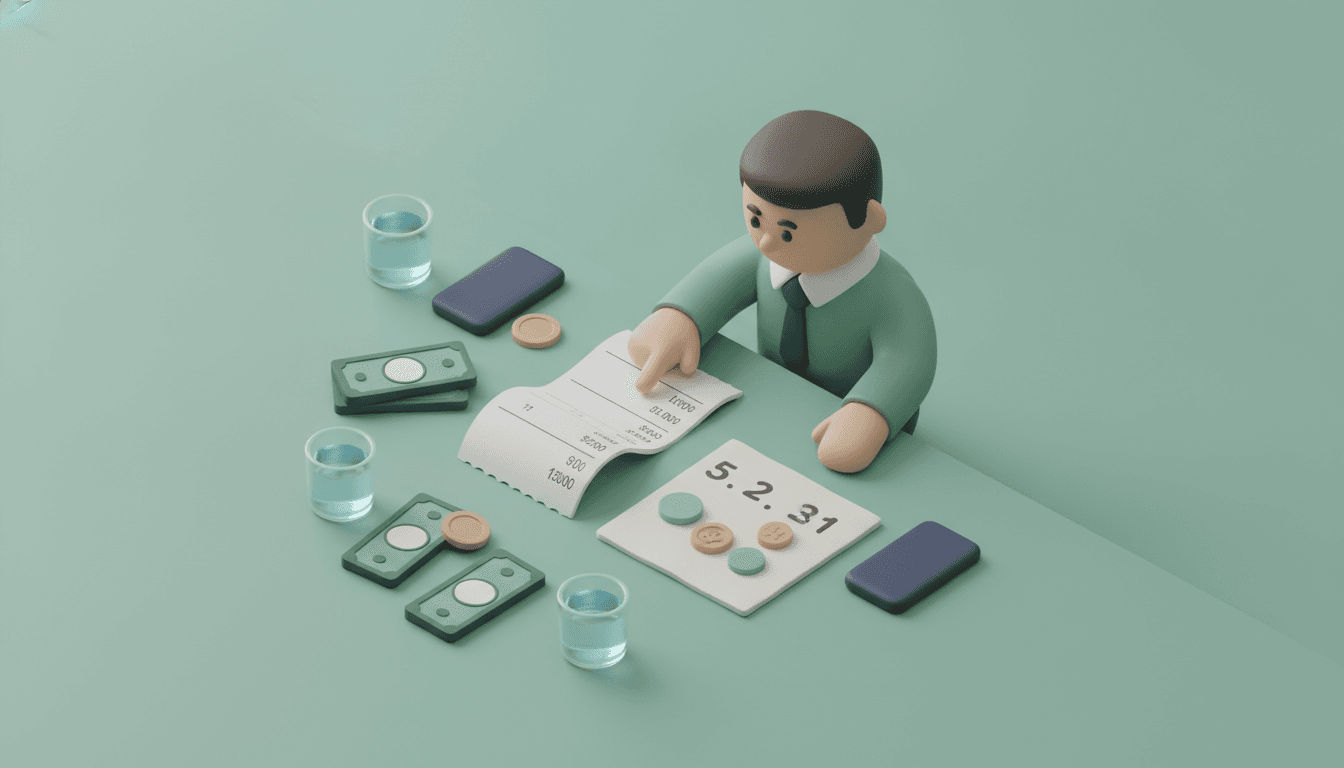
The foundation of bill splitting is straightforward: take the confirmed total—including tax and service charges—and divide it by the number of people. In reality, though, differences in seniority or drinking habits, rounding odd amounts, and multiple people paying upfront often mean simple division fails to balance the books.
Splitting the bill simply means dividing a shared expense among a group according to set rules, whether equally, by ratio, or by item. At Split The Bill, we work with these calculations every day. Here is a step-by-step walkthrough using real figures so organizers never come out at a loss and no one leaves feeling cheated.
Key takeaways
- An even split is calculated as "total including tax and service charge ÷ headcount"; for cash collection, rounding up to the nearest ¥100 is standard.
- Common weighted ratios for workplace dinners are 1.5–2.0x for department heads, 1.2–1.3x for middle management, and 0.5–0.7x for junior staff.
- Non-drinkers or guests arriving over an hour late typically get a fixed discount of ¥1,000–¥2,000 or pay only for food.
- When a 10% service charge and 10% consumption tax are added to a pre-tax ¥30,000 receipt, the final bill balloons to ¥36,300.
- When multiple people cover expenses, calculating each person's "amount paid − fair share" balance settles a four-person trip in at most three transfers.
Bill-splitting basics: How do you calculate an even split?
For an even split, divide the final total on the receipt (including tax and service charges) by the headcount, and round the figure depending on how people will pay. For example, dividing ¥47,300 among 9 people comes to ¥5,255.55... each. With cash, rounding up to ¥5,300 per person is practical—just make sure to state what happens to the ¥400 surplus ahead of time.
The math takes ten seconds on a calculator. Where friction arises is before and after:
- Before dividing: Is the receipt figure truly final? Are pre-tax subheadings, service fees, or late-night surcharges still pending?
- After dividing: How do you round the change? Who keeps the surplus? Who covers any shortfall?
Even with the same 9 people and a ¥47,300 tab, rounding increments drastically shift the outcome. Rounding up to the nearest ¥100 leaves a ¥400 surplus, but rounding up to the nearest ¥500 makes it ¥5,500 each—totaling ¥49,500 and creating a ¥2,200 surplus. That is far too much to quietly pocket as an organizer fee, and it creates awkwardness later.
If everyone ate and drank roughly the same amount, an even split is the fastest and least contentious approach. Only when conditions differ should you move to weighted splits.
How do you calculate a weighted split?
A weighted split works in three phases: remove the guest of honor, lock in fixed amounts for special cases, and distribute the remainder by ratio. Typical workplace multipliers are roughly 2.0x for department directors, 1.3x for managers, and 1.0x for general staff. Setting fixed amounts like ¥3,000 for non-drinkers or late arrivals before dividing the remainder keeps the math steady.
Ratio benchmarks by role and circumstance
At company gatherings, weighting based on role, tenure, and alcohol consumption has become the standard over gender-based discounts. Uniform discounts based on gender are best avoided.
| Role / circumstance | Target ratio | Typical amount (benchmark) |
|---|---|---|
| Executives / Department heads | 1.5–2.0x | ~¥10,000 |
| Middle managers (section heads) | 1.2–1.3x | ~¥8,000 |
| General staff | 1.0x | ~¥5,000 |
| Junior staff / New hires | 0.5–0.7x | ¥2,000–¥3,000 |
| Non-drinkers / 1+ hour late | Fixed reduction | ¥1,000–¥2,000 off regular rate, or food cost only |
| Guest of honor (farewell party, etc.) | 0 | Free |
Example: A farewell party of 12 people totaling ¥60,000
The breakdown: 1 guest of honor, 1 department head, 2 managers, 6 general staff, and 2 non-drinkers. Here is the step-by-step calculation:
- Exclude the guest of honor: They pay nothing. The pool remains ¥60,000, but headcount drops by one.
- Lock in fixed amounts: The 2 non-drinkers pay a flat ¥3,000 each. That leaves ¥60,000 − ¥6,000 = ¥54,000.
- Sum the ratio points: 1 director × 2.0 + 2 managers × 1.3 + 6 staff × 1.0 = 10.6 points.
- Find the cost per point: ¥54,000 ÷ 10.6 ≈ ¥5,094.
- Multiply and round for each group: Director pays ¥10,189 → ¥10,200; managers pay ¥6,623 → ¥6,700; staff pay ¥5,094 → ¥5,100 (rounded up to nearest ¥100).
- Verify the total: ¥10,200 + (¥6,700 × 2) + (¥5,100 × 6) + (¥3,000 × 2) = ¥60,200. Surplus: ¥200.
Setting flat amounts in step 2 is the key. Treating non-drinkers as a ratio like "0.6x" causes their share to fluctuate whenever the total changes, making it harder to explain. A flat rate like "yours is ¥3,000" settles the matter instantly.
How should you round fractions? Benchmarks by payment method
The right rounding unit depends on how everyone plans to pay. Rounding up to the nearest ¥100 or ¥500 works best for cash; workplace dinners with hierarchy tiers often use ¥1,000 increments; and peer-to-peer transfers like PayPay handle ¥1 or ¥10 increments effortlessly.
| Payment method | Recommended rounding | Reason |
|---|---|---|
| All cash | Round up to ¥100 (or ¥500) | Prevents holding up the register sorting change |
| Weighted corporate party | ¥1,000 units | Easy paper-bill collection; reflects seniority cleanly |
| All digital / cashless transfers | ¥1 or ¥10 | No friction handling exact fractions |
| Mixed cash and transfers | Round up to ¥100 | Accommodates the slower payment method |
Surplus handling generally follows two conventions: the organizer keeps small rounded-up change as compensation for booking, or senior colleagues cover remaining gaps. Even Casio's high-precision calculation site for bill splitting offers settings to allocate remainder amounts to senior members or discount the organizer's share.
Whichever approach you choose, decide before the event begins. If there is a few hundred to a thousand yen left over, telling everyone beforehand that it covers the organizer's effort or goes toward a coffee stop keeps everyone content. Announcing it after the fact, even for the same amount, looks dishonest.
Overlooking tax and service charge leaves the organizer in the red
The most frequent cause of organizer deficits is overlooking pre-tax pricing, service charges (5–15%), or late-night fees. If a pre-tax ¥30,000 tab incurs a 10% service charge and 10% consumption tax, the final bill becomes ¥36,300; collecting ¥5,000 each from 6 people based on the ¥30,000 subtotal leaves a ¥6,300 shortfall.
The math follows: pre-tax total × 1.1 (service charge) × 1.1 (10% tax). Because some venues apply consumption tax on top of the service fee, the total is slightly higher than a flat 20% addition.
There are only two ways to prevent this:
- Split only after seeing the final total: When booking a set course, confirm the exact total including tax and service charges beforehand.
- Add a buffer if collecting in advance: Collect roughly 10% above the estimate, refunding the remainder or rolling it into a second venue.
Asking "What is the total cost per person including all taxes and service fees?" right when booking saves a substantial amount of calculation on the day.
How do you settle up when multiple people paid upfront?
When several people cover different expenses, avoid settling each receipt one by one. Instead, sum every expense, divide by headcount to find each person's fair share, and calculate "amount paid − fair share." This net-balance method settles everything in at most (headcount − 1) transfers.
Example: Settling a 4-person trip
| Person | Amount fronted | Fair share | Balance |
|---|---|---|---|
| A (Lodging) | ¥48,000 | ¥20,000 | +¥28,000 (Receives) |
| B (Rental car) | ¥24,000 | ¥20,000 | +¥4,000 (Receives) |
| C (Meals) | ¥8,000 | ¥20,000 | −¥12,000 (Pays) |
| D | ¥0 | ¥20,000 | −¥20,000 (Pays) |
With a total of ¥80,000, each person owes ¥20,000. Settlement requires only three transfers: D pays A ¥20,000, C pays A ¥8,000, and C pays B ¥4,000.
Trying to settle receipt by receipt—having C and D pay A for lodging, while A, C, and D pay B for the rental car—requires six or more transactions, and someone almost always makes an error. Sum first, then settle net balances. That is the single most important rule for multi-expense trips. For handling multi-currency receipts or multi-day journeys, our guide to settling shared expenses online outlines the complete workflow.
Itemized splits, travel expenses, and roommate expense sharing
An itemized split assigns each line item on a receipt to whoever ordered it, dividing shared dishes evenly. For gatherings where one expensive bottle of wine would skew things, or casual meals where portions differ widely, itemizing resolves issues faster and feels fairer than tweaking arbitrary ratios.
Each scenario fits a specific method best:
- Large parties: Even or weighted splits. Itemizing creates unnecessary overhead.
- Small meals (2–5 people): Itemized splits. Split wine costs only among those who drank.
- Trips, BBQs, golf outings: Log all fronted expenses and settle net balances at the end.
- Shared apartments (rent & utilities): Prorate by bedroom square footage or time spent at home, automating the same ratio every month.
For housemates, repeating the same manual calculations every month is the biggest chore. Our guide to splitting rent with roommates covers practical square-footage calculations with concrete figures.
Regarding tools: for one-off weighted splits, simple calculator sites like Casio's keisan are quick and capable. If everyone is on a LINE group chat, in-app calculation bots are also convenient. However, when expenses pile up over multi-day trips or ongoing shared living, tools that keep a running record and compute minimal debt transfers become far easier. We break down the top options in our comparison of bill-splitting apps.
Frequently asked questions
Is it rude to split a bill down to the exact single yen?
When collecting cash, counting out single yen coins holds up the payment and can frustrate people. If everyone uses instant mobile transfers like PayPay, splitting down to the exact yen causes no friction and is often preferred as completely fair. When in doubt, rounding down to the nearest ¥10 keeps the organizer's buffer within headcount × ¥9.
How should we calculate the guest of honor's portion at a farewell party?
Exclude the guest of honor from the headcount before doing any weighted or even divisions, and divide the full tab among the remaining attendees. If anyone contributed a gift fund or extra sponsorship money, deduct that from the total before calculating shares. Doing this out of order skews the ratio weights and distorts everyone's payment.
Should women pay less at group dinners?
At workplace dinners, uniform discounts by gender have fallen out of favor. Basing differences on alcohol consumption, seniority, or job band achieves fair price distinctions while remaining justifiable to everyone. When applying tiered pricing for social mixers, ensure everyone agrees on the arrangement beforehand.
Can the organizer keep leftover money from rounding up?
Keeping a small surplus of a few hundred to a thousand yen as compensation for organizing is customary, provided you inform everyone in advance. If rounding creates a surplus larger than ¥200 per person, reduce the rounding interval or put the extra money toward drinks at the next stop.
Three things to agree on beforehand so nobody argues over the bill
Almost every dispute over splitting bills comes down to things left unsaid before the check arrives. Before your next gathering or trip, settle these three points with your group:
- The split method: Even, weighted, or itemized? If weighted, what are the flat rates for non-drinkers or late arrivals?
- Rounding units and surplus destination: Round to ¥100 or ¥1,000? Does the remainder go to the organizer or to the next round?
- Payment method: Cash or digital transfer? If multiple people front costs, confirm that net balances will be settled at the end.
For events with multiple receipts or shared monthly bills, try Split The Bill. Simply snap a photo of your receipt to read line items automatically, then split evenly, by custom shares, or item by item. Instead of relying on uncertain AI guesses, calculations follow clear formulas to produce reliable totals every time, with debt consolidation automatically minimizing transfers.
All you have to do is share a link with your group. No app download and no registration required. Even friends who dread installing another app can check their share directly in their browser. The Free plan is free forever, with no credit card required. No surprises.
Quick FAQ
Is it rude to split a bill down to the exact single yen?
When collecting cash, counting out single yen coins holds up the payment and can frustrate people. If everyone uses instant mobile transfers like PayPay, splitting down to the exact yen causes no friction and is often preferred as completely fair. When in doubt, rounding down to the nearest ¥10 keeps the organizer's buffer within headcount × ¥9.
How should we calculate the guest of honor's portion at a farewell party?
Exclude the guest of honor from the headcount before doing any weighted or even divisions, and divide the full tab among the remaining attendees. If anyone contributed a gift fund or extra sponsorship money, deduct that from the total before calculating shares. Doing this out of order skews the ratio weights and distorts everyone's payment.
Should women pay less at group dinners?
At workplace dinners, uniform discounts by gender have fallen out of favor. Basing differences on alcohol consumption, seniority, or job band achieves fair price distinctions while remaining justifiable to everyone. When applying tiered pricing for social mixers, ensure everyone agrees on the arrangement beforehand.
Can the organizer keep leftover money from rounding up?
Keeping a small surplus of a few hundred to a thousand yen as compensation for organizing is customary, provided you inform everyone in advance. If rounding creates a surplus larger than ¥200 per person, reduce the rounding interval or put the extra money toward drinks at the next stop.
Try Split The Bill — free
10 receipt-scanned bills/month, recurring expenses, multi-currency, and settle-up via Venmo / PayPal / Revolut.
Create a free accountRelated posts

Bill Splitter App: How to Choose the Right One
A bill splitter app divides shared costs, tracks who owes what, and settles up automatically. Compare top picks, costs, and features before you download
- Bill
- Splitter

The Right Splitwise Alternative Depends on Your Group
Hit Splitwise's daily limit? Compare the best Splitwise alternative options for trips, roommates, and dinners, then find your group's right fit.
- Apps
- Splitwise
- Splitting
Splitting expenses online: a practical 2026 guide
How to split expenses online without spreadsheets: division modes, settling up with fewer bank transfers, and friends who do not need to download apps. Check out the step-by-step guide.
- App
- Expenses
- Splitting


