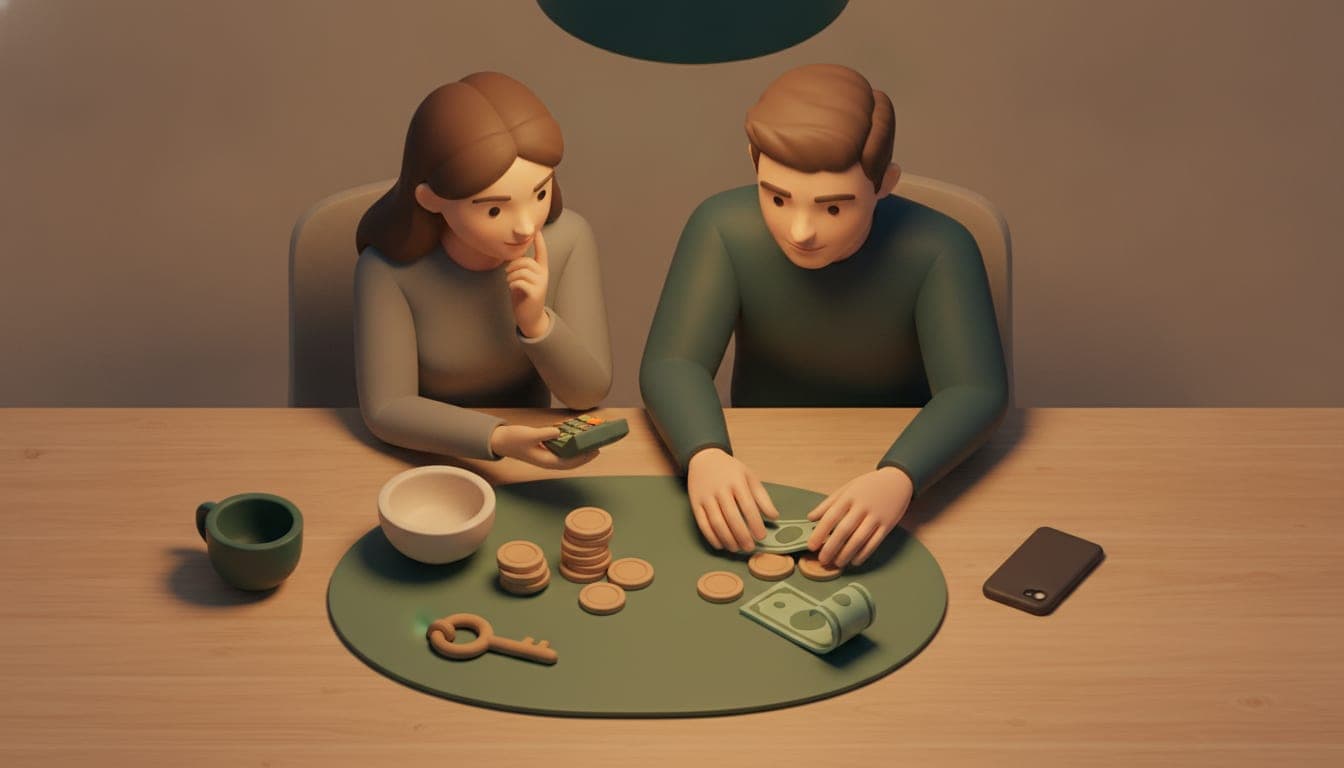
Who Owes Whom After the Trip? A Trip Expense Splitter Calculator
Trip expense splitter: subtract your share from what you paid to get your balance. Example with 4 friends and $820 where the balances add up to 0.
Split a receipt in seconds, no sign-up needed.
Scan one free
To split the costs of a group trip with a trip expense splitter, subtract each person's equal share of the total from what they paid: that number is their balance. If it's positive, they're owed money. If it's negative, they owe.
A shared trip expense calculator is a tool (or a hand-made table) that turns several receipts paid by different people into one figure per person. Here we do it with a four-friend trip, no tricks, by hand.
Key takeaways
- Work out your balance in two steps: add up what you paid, then subtract the trip total divided by the number of participants. A positive result means you collect; a negative one means you pay.
- If someone skipped an expense, split that expense only among the people who enjoyed it. In the example, a $120 dinner without David lowers his share from $205 to $175.
- Before sending any figure to the group, add up all the balances: they have to come to exactly 0. If they don't, a receipt is missing, one is extra, or a cent was rounded wrong.
What is the rule behind a shared trip expense calculator?
This rule works when everyone took part in every expense.
In four steps:
- Write down each receipt with its amount and who paid it.
- Add up all the amounts to get the total.
- Divide the total by the number of people: that's each person's share.
- Add up what each person paid and subtract that share.
A spreadsheet does exactly this with a balance column and a sum (the shared expenses spreadsheet checklist details the columns). An app does the same: in Split The Bill the AI scanner only reads the receipt, and the calculation afterward is deterministic, not an AI estimate.
How much does everyone owe on a shared trip of 4 friends and $820?
With five expenses adding up to $820 among four people, each person owes $205 (820 ÷ 4). Ana paid $550 and gets back $345. Bruno, Carla and David owe $115, $85 and $145.
| Expense | Amount | Paid by |
|---|---|---|
| Lodging | $480 | Ana |
| Trains | $90 | Bruno |
| Dinner | $120 | Carla |
| Groceries | $70 | Ana |
| Tickets | $60 | David |
| Total | $820 |
Ana paid two receipts (480 + 70 = $550). The others paid one each.
| Person | Paid | Their share | Balance |
|---|---|---|---|
| Ana | $550 | $205 | +$345 |
| Bruno | $90 | $205 | −$115 |
| Carla | $120 | $205 | −$85 |
| David | $60 | $205 | −$145 |
| Total | $820 | $820 | $0 |
Note that Ana isn't "putting in" $550 of her own money for good: she only fronted $345 more than her share.
How do I turn balances into actual transfers?
Pair up the people with negative balances with the people with positive balances until everyone is at zero. With n people, at most n − 1 transfers are enough.
When there are several creditors, the pairing gets a little trickier. Imagine four balances: +$50, +$30, −$40 and −$40. The first debtor pays $40 to the person at +$50 (leaving them at +$10). The second debtor pays $10 to that same person and $30 to the one at +$30. Three transfers, everything at zero, and there's no way to do it in fewer because no subset of the balances adds up to 0 on its own.
Without netting, each person would pay each payer their share of every receipt, with many more transactions.
What if someone didn't take part in an expense?
If David didn't go to the $120 dinner, that expense is split among three ($40 each) and the other four expenses, which add up to $700, stay split among four ($175 each).
| Person | Paid | Their share | Balance |
|---|---|---|---|
| Ana | $550 | $215 | +$335 |
| Bruno | $90 | $215 | −$125 |
| Carla | $120 | $215 | −$95 |
| David | $60 | $175 | −$115 |
| Total | $820 | $820 | $0 |
How do I check that the result adds up?
Add up everyone's balances: they must come to exactly 0. If they come to anything else, the error is an unrecorded receipt, a duplicated one, or a badly done split. It's a quick test because it doesn't require recalculating anything.
Three checks, from quickest to finest:
- Total paid = sum of receipts. In the example, 550 + 90 + 120 + 60 = $820.
- Total shares = sum of receipts. If a share doesn't add up, an expense was split among more or fewer people than it should have been.
The awkward case is cents. A $100 dinner among three comes to $33.33 a head, which adds up to $99.99. Assign the missing cent to one person ($33.34 / $33.33 / $33.33) so the shares add up to the real total and the final balance is still 0.
If part of the trip was paid in another currency, convert each receipt into a single currency with one exchange rate before adding up (here's how to split expenses in different currencies).
Frequently asked questions
Do you always have to split things equally?
No. If a couple travels with three friends, you can count five shares and have the couple pay two. In the example, the couple would pay two shares and each of the others one. The balance rule doesn't change, only the number you divide by.
Do the others have to install anything to see their balance?
With Split The Bill, no: the group is shared with a web link, and whoever opens it sees their balances without downloading anything or creating an account. If someone prefers to pay through a payment app, the figure is the same.
How do I do this without typing in five receipts by hand?
Today, put all the trip's receipts in one place with the amount and who paid, and apply the balance rule. With Split The Bill, the settlement comes out with the fewest possible transfers.
Try Split The Bill — free
10 receipt-scanned bills/month, recurring expenses, multi-currency, and settle-up via Venmo / PayPal / Revolut.
Create a free accountRelated posts
How to Split Expenses in Different Currencies Without a Calculator
Split expenses in different currencies with one base currency, an exchange rate fixed in advance and a settlement with the fewest possible transfers.
- Travel
- Settling up
- Expenses
Splitting Car Trip Costs: Fuel, Tolls, Parking
Splitting car trip costs: kilometers × consumption × price per liter, plus tolls and parking. Example for 4 people with three payments to the driver.
- Travel
- Expenses
- Splitting

Settling up with friends in Splid: from filling the tank to the final transfer
Settle up with friends in Splid without arguing over receipts: a checklist for every trip phase, a worked example with five people and a clean settlement.
- Travel
- Kosten
- Aufteilen