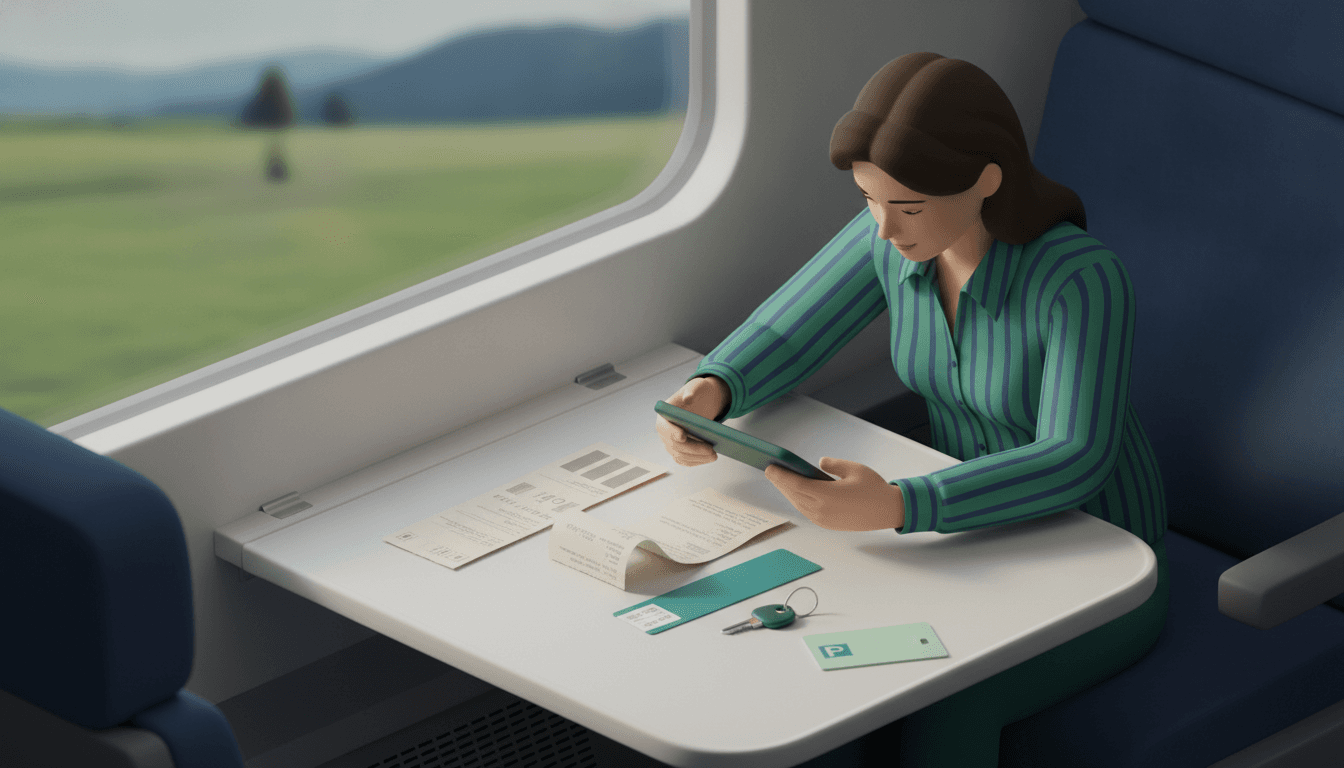
Splitting Car Trip Costs: Fuel, Tolls, Parking
Splitting car trip costs: kilometers × consumption × price per liter, plus tolls and parking. Example for 4 people with three payments to the driver.
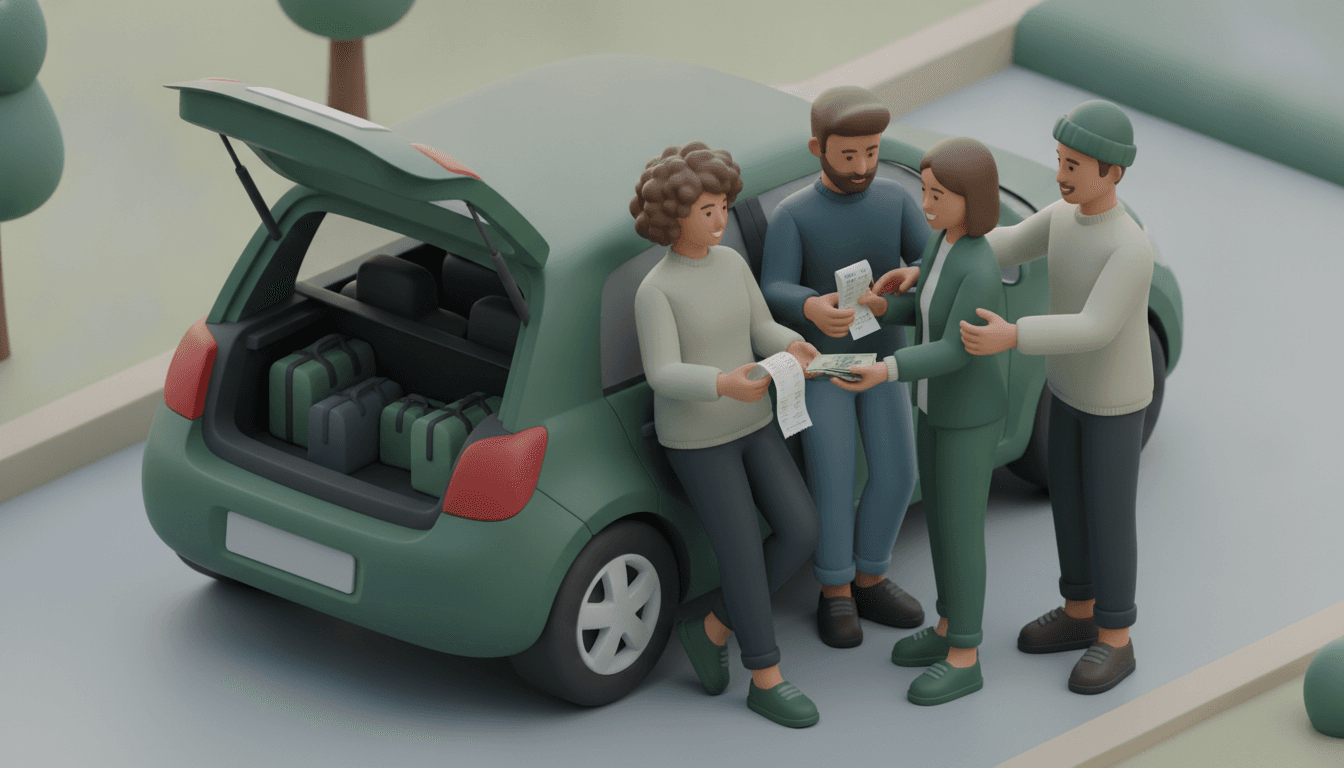
Splitting car trip costs comes down to one line: kilometers driven × consumption per 100 km ÷ 100 × price per liter + tolls + parking, all divided by the number of passengers. A trip cost split is a calculation in which each passenger pays an equal share of the actual expenses of the trip, not “roughly a full tank each.” For a weekend trip with three friends, it takes about ten minutes, and the last payment arrives the same day.
Key takeaways
- Calculate fuel from kilometers driven and actual consumption, not from the number of tanks filled. That way there is no dispute over who filled up where.
- Track tolls and parking as separate items for both directions. Receipts are proof, so nobody has to guess from memory.
- The driver normally pays the same share as the passengers, because the total is split among everyone in the car. If the group exempts the driver, the divisor is the number of passengers without them, and that adds about a third to everyone else's bill.
- Everyone calculates “paid minus share”: whoever is in the red pays whoever is in the black, so for 4 people there are at most 3 payments.
What goes into trip costs: fuel, tolls, parking, or depreciation too?
The shared bill includes fuel, tolls and parking, because those are expenses you can show with a receipt or an odometer reading. Depreciation, insurance, registration and servicing are included only if the group agrees on it in advance.
| Item | Included in the split? | How it is measured |
|---|---|---|
| Washing, servicing, tires | No, unless agreed | Individual receipt |
| Depreciation | No, unless agreed | A fixed amount per kilometer that the group sets itself |
Step 1: How do you calculate fuel cost from consumption and price per liter?
Fuel cost is the distance driven in kilometers multiplied by consumption per 100 km, divided by 100 and multiplied by the price per liter. A car that uses 7 l/100 km with fuel at 190 RSD per liter (the example amounts in this article are in Serbian dinars, RSD) costs 13.30 RSD per kilometer.
Don't take consumption from the manufacturer's spec. Measure it:
- Fill up to full before departure and reset the trip meter.
- After the trip, fill up to full at the same station and write down the liters from the receipt.
- Divide the liters by the kilometers driven and multiply by 100.
If you don't have time to measure, take the average from the car's trip computer, but check it at the pump at least once. The computer can show something different from what you actually use.
Take the price per liter from the receipt. If you filled up at two stations at different prices, use the average weighted by liters, not a plain average of the two prices.
Step 2: How do you add up tolls and parking for both directions?
Tolls and parking shouldn't be estimated: they are added up from receipts, with each toll station and each parking lot as a separate item. If the trip in one direction cost 900 RSD in tolls, the return is counted separately, because the amount may not be the same. A forgotten return toll leaves the driver out of pocket.
Photograph every receipt right away, on the spot. A card or electronic toll payment leaves a trace, but once the receipt is lost, all that remains is “I think it was around 900.” In a shared-expense app such as Split The Bill, you can photograph the receipt and split it by item, and if it carries a QR code, you can scan it.
For trip costs in a foreign currency, write down the amount in the currency in which it was paid. The tool does the conversion, once, at a rate the group agrees on.
Step 3: Does the driver pay their share of the trip costs?
As a rule, yes: the driver pays the same share as a passenger, which means the total cost is divided by the number of all people in the car, including them. The logic is simple: the trip is made because of the whole group. So it makes no sense for three people to pay for the entire car.
There is another variant. If the driver is the owner and wanted to drive alone, and the others joined in, the group can exempt them from a share, and the total is divided by the number of passengers without the driver.
A middle path is for the driver to pay their share of the fuel, while the passengers cover tolls and parking.
Step 4: How do you split the total and who pays whom?
Divide the total by the number of people, then subtract from each person what they have already paid. Whoever paid less than their share owes the difference, and whoever paid more receives it.
The sum of all balances must always be zero. If it isn't, a wrong amount was entered somewhere, and it's better to see that before you send the message to the group.
When there were more payments than just the driver's, the number of transfers can be reduced. Split The Bill calculates this deterministically, with plain arithmetic, not an AI estimate: the same input always gives the same result.
Example: what does a trip cost breakdown look like for 4 people, from departure to the last payment?
A driver and three friends go away for the weekend, 320 km in one direction. The input data are assumptions for the sake of the calculation: consumption 7 l/100 km, fuel 190 RSD per liter, tolls 900 RSD in each direction, parking 1,200 RSD in total.
| Item | Calculation | Amount |
|---|---|---|
| Fuel | 640 km × 7 ÷ 100 × 190 | 8,512 RSD |
| Tolls | 900 + 900 | 1,800 RSD |
| Parking | one receipt | 1,200 RSD |
| Total | 11,512 RSD |
Each person's share: 11,512 ÷ 4 = 2,878 RSD.
The driver paid for the fuel and the outbound toll (9,412 RSD in total). Friend B paid the return toll of 900 RSD, friend C paid the parking of 1,200 RSD, and friend D paid nothing.
| Person | Paid | Share | Balance |
|---|---|---|---|
| Driver | 9,412 | 2,878 | +6,534 |
| B | 900 | 2,878 | −1,978 |
| C | 1,200 | 2,878 | −1,678 |
| D | 0 | 2,878 | −2,878 |
The balances sum to zero: 6,534 − 1,978 − 1,678 − 2,878 = 0. There are three payments: B sends the driver 1,978 RSD, C sends 1,678 RSD, D sends 2,878 RSD. Nobody owes anyone else anything.
If the group decides that the driver doesn't pay a share, the total of 11,512 RSD is divided among three: 3,837.33 RSD per passenger, which is rounded by a rule agreed in advance (for example, a surplus or shortfall of a dinar or two that the driver covers).
What mistakes ruin a trip cost split?
- Rounding up for everyone. If you ask for 3,000 from a share of 2,878 RSD, the driver has earned 488 RSD from four people. Round only if everyone agrees.
Frequently asked questions
How do you split costs when someone gets out or in along the way?
Split the trip into legs and calculate each one separately: divide the leg's kilometers and tolls by the number of passengers who were in the car for that part. A passenger who got out halfway pays a share only for the first leg. The driver doesn't split the fuel for an empty leg with anyone.
Is it legal for passengers to reimburse the driver's costs?
Rules on paid passenger transport differ from country to country, and sometimes within a country. A one-time shared trip among friends is a different situation from regularly driving the same people on a route that a bus line covers, so if you do the latter, check the rules that apply where you live first.
What if friends don't want to install yet another app?
They don't have to. In Split The Bill it is enough to send them a link, and they see their amount and who pays whom, without an account.
How can you send the breakdown to the group today?
Enter fuel, tolls and parking in Split The Bill: the app calculates each passenger's share and the smallest number of payments, and you send the group a single link.
Try Split The Bill — free
10 receipt-scanned bills/month, recurring expenses, multi-currency, and settle-up via Venmo / PayPal / Revolut.
Create a free accountRelated posts
Settling up with friends in Splid: from filling the tank to the final transfer
Settle up with friends in Splid without arguing over receipts: a checklist for every trip phase, a worked example with five people and a clean settlement.
- Travel
- Kosten
- Aufteilen
8 checks for calculating petrol costs and splitting them fairly without shortchanging the driver
Learn how to calculate petrol costs and split expenses using 8 essential checks. From distance and fuel efficiency to toll reimbursements and driver discounts.
- Travel
- Expenses
- Splitting

Travel Expense Splitting App in 2026
Compare the best travel expense splitting apps in 2026: foreign currency, offline mode, and apps that don't require friend registration.
- Apps
- Travel
- Expenses