
8 checks for calculating petrol costs and splitting them fairly without shortchanging the driver
Learn how to calculate petrol costs and split expenses using 8 essential checks. From distance and fuel efficiency to toll reimbursements and driver discounts.
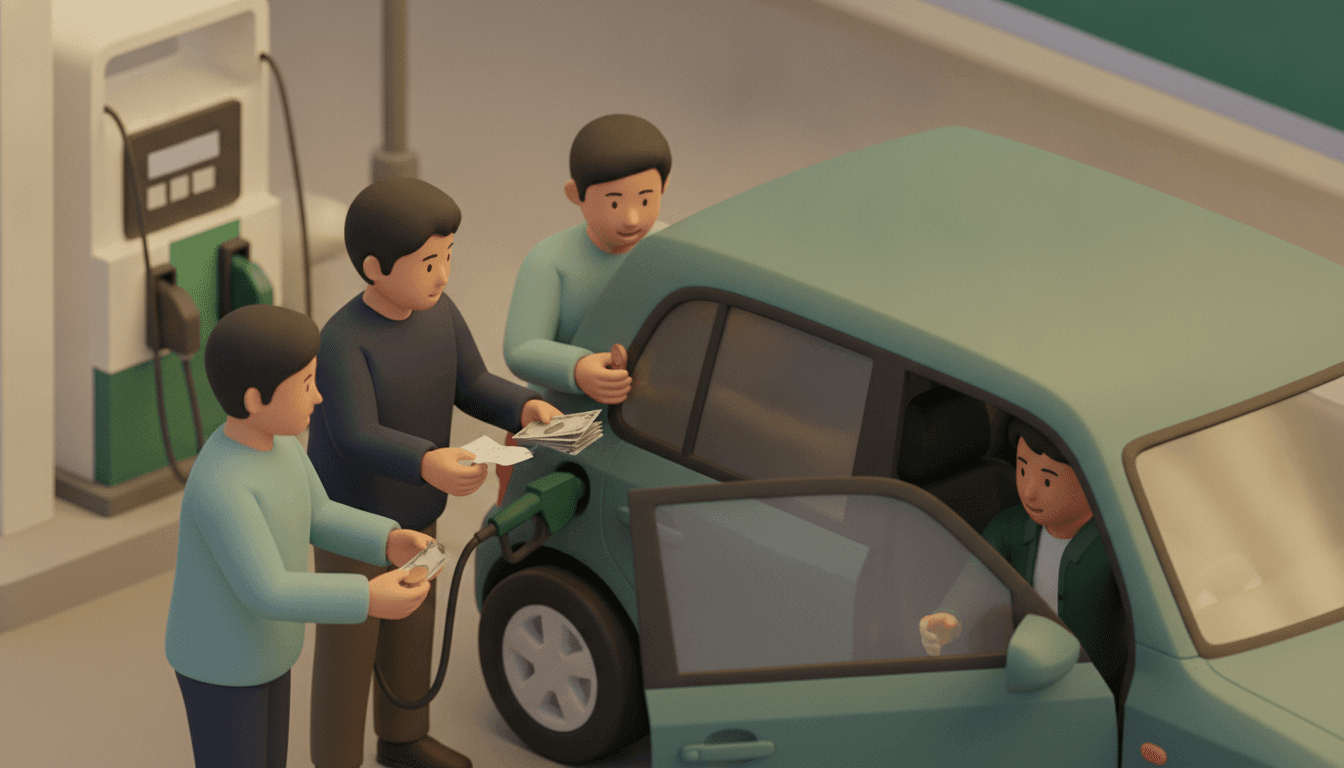
Petrol costs are calculated using the formula "Driving distance ÷ Actual fuel efficiency × Petrol unit price," and splitting expenses typically involves combining toll and parking fees before dividing by the number of passengers. However, if you use a per capita split where the person who provided the car pays the exact same amount, the owner ends up bearing the costs of tires, oil, and car washes on their own.
Splitting petrol costs means dividing the fuel and incidental expenses incurred during a trip into a ratio that all passengers can agree upon. There are 8 checks to cover: 3 for distance and fuel efficiency, 3 for allocation, and 2 for reimbursements.
Key takeaways
- Petrol costs are calculated as "Driving distance (km) ÷ Actual fuel efficiency (km/L) × Unit price (yen/L)." For example, 240 km, 15 km/L, and 170 yen/L equals 16 liters costing 2,720 yen.
- The basic share per person is "(Petrol + Tolls + Parking + Miscellaneous) ÷ Number of passengers."
- For private cars, common choices include counting the driver as 0.5 people ("driver half-price") or excluding the driver entirely ("driver free").
- For long trips with refuelling stops or rental cars, the tank-to-tank method—filling the tank before departure and upon return and splitting the receipt amount—is the least contentious approach.
- Rounding fractional amounts up to the nearest 10 yen and giving the difference to the driver allows you to handle accurate calculations and gratitude all at once.
How to calculate petrol costs: 3 checks for distance and fuel efficiency
To get an accurate petrol cost, you need three numbers: the trip meter reading, the average fuel efficiency on the vehicle display, and the actual unit price refuelled. Calculating based on catalogue fuel efficiency tends to yield a lower figure than reality, with the difference absorbed silently by the car owner.
1. Did you reset the trip meter to zero upon departure? If you reset it at the starting point, the reading upon return becomes your exact round-trip distance, saving you the trouble of guessing later with a map app.
2. Are you using the average fuel efficiency from the car display rather than catalogue figures? Catalogue WLTC mode fuel efficiency tends to be more optimistic than real-world driving, resulting in a calculation that favors passengers more on days with traffic or mountain roads.
3. Are you using the actual refuelling price for the unit price? National average retail prices are published weekly by the Agency for Natural Resources and Energy Petroleum Product Price Survey. Even so, prices vary by region, station, and regular versus high-octane, so the unit price on your most recent receipt is the most reliable.
Choose your calculation method based on the car and the itinerary. The meter calculation method suits private cars without refuelling stops, while the full-tank method suits rental cars or long journeys involving refuelling.
| Method | Best suited for | Requirements | Caveats |
|---|---|---|---|
| Meter calculation | Private cars, no mid-trip refuelling | Distance, average efficiency, unit price | Unusable in cars without efficiency displays |
| Full-tank method | Rental cars, long trips, mid-trip refuelling | Pre-departure and return full-tank receipts | Fails if you forget to fill up before departure |
Because the full-tank method settles things with "Total receipt amount ÷ Number of people," no one can argue with the formula. Having a single receipt as the source of truth carries more persuasive power than you might expect.
Should petrol be split equally or weighted? 3 agreements to make beforehand
For casual short trips among students, an equal split is standard, whereas for long trips or borrowing a friend's private car, a "driver half-price" or "driver free" arrangement is common. Whichever method you choose, decide on it before setting off. Bringing it up on the way back forces the owner to advocate for their own share.
4. Did you decide on the allocation method in the group chat before departure? Deciding beforehand makes it a simple confirmation of rules, whereas bringing it up during settlement can make you look stingy.
5. Are you adding an allowance for wear and tear or car washes, or absorbing it in the fractions? Depreciation, inspections, insurance, oil changes, and tire wear are not included in actual out-of-pocket petrol costs at all.
6. How do you handle someone who took turns driving? If two people shared the driving, treating both as 0.5 shares ensures fairness and leaves no sense of unfairness for those who took on labor.
Comparing the three methods using the same total cost makes the differences clear. This example assumes 2,720 yen for petrol, 4,000 yen for tolls, 1,000 yen for parking, totaling 7,720 yen split among 4 people (unit prices and fees are calculation examples).
| Method | Passenger share (rounded up to 10 yen) | Driver's actual burden | Best suited for |
|---|---|---|---|
| Equal split | 1,930 yen | 1,930 yen | Short trips, rentals, shared driving |
| Driver half-price (0.5 share) | 2,210 yen | 1,090 yen | Day trips or overnight stays in private cars |
| Driver free | 2,580 yen | 0 yen (20 yen surplus) | Long trips, single designated driver |
The half-price calculation is "7,720 yen ÷ 3.5 shares = approx. 2,206 yen." When 3 passengers pay 2,210 yen rounded to the nearest 10 yen, the total is 6,630 yen, keeping the driver's burden at 1,090 yen (7,720 yen minus 6,630 yen). Splitting costs using ratios follows the same reasoning as deciding fair household expense sharing ratios.
Can tolls and parking be bundled with petrol? 2 reimbursement checks
Bundling them is fine, provided you record "who paid how much" per expense before adding them up. If payers are split—for instance, tolls on the driver's ETC card and parking paid in cash by the front passenger—the total amount alone won't tell you who needs to pay whom and how much.
7. Did you keep a record of who paid and how much for each item? Taking a quick photo of ETC usage statements or coin parking receipts on the spot saves you from racking your brain later asking who paid for what.
8. Did you separate sections for people who joined or left midway? Charging a round-trip share to someone who only rode the outbound leg is unfair to them. Keeping track of expenses section by section prevents this.
You should also decide the scope of weighted allocations. It is common to apply driver discounts only to petrol and tolls while splitting parking and meals equally among everyone.
Even when reimbursements are split across two people, netting them out reduces transfer frequencies. Consider a case using the half-price method where the driver advanced 6,720 yen for petrol and tolls, and person A advanced 1,000 yen for parking. Subtracting A's 1,000 yen advance from their 2,210 yen share means A sends 1,210 yen to the driver. Persons B and C send 2,210 yen each. There are 3 transfers, and the driver's actual burden becomes 1,090 yen, matching the table. Online methods for settling shared expenses among multiple people operate on this same offset logic.
How much per person for a 4-person, 240 km round trip? Step-by-step example
For a 240 km round trip, 15 km/L average efficiency, 170 yen/L unit price, 4,000 yen round-trip tolls, 1,000 yen parking, 4 passengers with a driver half-price setup, each passenger pays 2,210 yen and the driver's actual burden is 1,090 yen. The 6 steps can be calculated with a single calculator if followed in order.
- Check the round-trip distance on the trip meter (240 km).
- Divide distance by average efficiency to find fuel consumed (240 ÷ 15 = 16 L).
- Multiply fuel volume by unit price to get petrol cost (16 × 170 = 2,720 yen).
- Add tolls and parking to find the total (2,720 + 4,000 + 1,000 = 7,720 yen).
- Count people by their share ratios and divide (3 passengers + 0.5 driver = 3.5 shares, 7,720 ÷ 3.5 ≒ 2,206 yen).
- Round up to the nearest 10 yen, offset per payer, and finalize transfer amounts (passenger share: 2,210 yen).
Always round fractions up toward the car owner. The difference is only a few dozen yen, but the impression of someone paying extra goes further than the amount itself. The basics of headcounts and rounding are covered in detail in the bill-splitting calculation guide.
The 3 most important checks to ensure the driver is completely satisfied
Out of the 8 checks, the ones directly tied to driver dissatisfaction are whether you calculated using actual efficiency, agreed on allocation methods beforehand, and rounded in favor of the driver. If these three are missing, even a mathematically correct calculation leaves the car owner with a sense of getting the short end of the stick.
Did you calculate using actual efficiency? Calculating with catalogue efficiency underestimates petrol costs, leaving the owner to cover the shortfall.
Did you decide on allocation methods beforehand? Pre-arranged rules eliminate the awkwardness of the car owner having to ask for preferential treatment.
Did you round in favor of the driver? Rounding up by 10-yen increments serves as a casual, unspoken thank-you for car washes and oil changes.
Another important rule is to ensure the driver isn't the one bringing up money. If an organizer among the passengers crunches the numbers and announces that it's 2,210 yen per person, the driver simply receives it. Much like drinking parties where arguments break out over who drank wine, awkwardness stems more from who brings up the topic than the money itself.
Frequently asked questions
Is it rude to ask the person who provided the car to pay for petrol too?
It is not rude, but for private cars, treating the driver at half-price or free is more natural. If the car owner explicitly requests an equal split, you may follow that. In such cases, add alternative tokens of appreciation, such as treating them to a drink at a convenience store on the way back or adding a few hundred yen as a car wash contribution.
Should the driver be favored when using a rental car too?
Since rental cars involve no wear and tear on personal vehicles, splitting the rental fee, insurance, and petrol equally among all participants—including the driver—is standard. Because the only favor is driving effort, some groups keep discounts lighter than a 0.5 share, around 0.8 shares. The full-tank receipt upon return serves directly as the basis for petrol costs.
How do you calculate petrol for someone who got dropped off midway?
Calculate based on the proportion of distance they rode. For instance, if someone rode only the first 120 km of a 240 km round trip, their burden is the petrol and outbound tolls divided by the number of people on that section. Expenses for sections they didn't ride, such as return parking, are not charged.
Are there apps that automatically calculate fuel efficiency by car model?
Yes. NAVITIME Drive Supporter lets you register a license plate to automatically retrieve model-specific fuel efficiency and petrol prices, handling split calculations for up to 9 people. However, since situations vary where not every passenger has the app installed, a practical approach is to calculate fuel costs on a dedicated app while handling settlements via shared links.
How to set up your next drive so the driver never hesitates to ask
Do three things. Decide on allocation methods in the group chat before departure. Record payers and amounts item by item during the trip. Upon return, have the organizer calculate amounts and transfer on behalf of the driver. This way, the driver simply receives funds without having to say a word.
With Split The Bill, you enter petrol, tolls, and parking by payer, set weightings like a 0.5 driver share, and generate settlement amounts with the minimum number of transfers. Calculations rely on consistent formulas rather than AI guesswork. Passengers open a shared link to check their individual shares right in the browser. The Free plan requires no app downloads and no card registration, and is permanently free. There are no catches.
If you have friends reluctant to install yet another app, combine this with the workflow from trip splitting without apps. Send the link. Check the amount. Pay. That's it.
Quick FAQ
Is it rude to ask the person who provided the car to pay for petrol too?
It is not rude, but for private cars, treating the driver at half-price or free is more natural. If the car owner explicitly requests an equal split, you may follow that. In such cases, add alternative tokens of appreciation, such as treating them to a drink at a convenience store on the way back or adding a few hundred yen as a car wash contribution.
Should the driver be favored when using a rental car too?
Since rental cars involve no wear and tear on personal vehicles, splitting the rental fee, insurance, and petrol equally among all participants—including the driver—is standard. Because the only favor is driving effort, some groups keep discounts lighter than a 0.5 share, around 0.8 shares. The full-tank receipt upon return serves directly as the basis for petrol costs.
How do you calculate petrol for someone who got dropped off midway?
Calculate based on the proportion of distance they rode. For instance, if someone rode only the first 120 km of a 240 km round trip, their burden is the petrol and outbound tolls divided by the number of people on that section. Expenses for sections they didn't ride, such as return parking, are not charged.
Are there apps that automatically calculate fuel efficiency by car model?
Yes. NAVITIME Drive Supporter lets you register a license plate to automatically retrieve model-specific fuel efficiency and petrol prices, handling split calculations for up to 9 people. However, since situations vary where not every passenger has the app installed, a practical approach is to calculate fuel costs on a dedicated app while handling settlements via shared links.
Try Split The Bill — free
10 receipt-scanned bills/month, recurring expenses, multi-currency, and settle-up via Venmo / PayPal / Revolut.
Create a free accountRelated posts

Splitting travel expenses without downloading an app: 8 checks
Split expenses without downloading a travel app: 8 checks for tolls, fuel, groceries, and dinners, with final settlements in just a few Pix transfers.
- Travel
- Expenses
- Splitting

Travel Expense Splitting App in 2026
Compare the best travel expense splitting apps in 2026: foreign currency, offline mode, and apps that don't require friend registration. See which one to choose.
- Apps
- Travel
- Expenses

Household Expense Split Calculator: 64/36
Fair household expense splitting using a calculator: formula, sample table with 3,200 € and 1,800 € net, and the marginal job edge case. Recalculate now.
- Kosten
- Aufteilen
- Expenses