
Receipt scanning and bill splitting: the 2026 guide
Learn how receipt scanning and bill splitting work via fiscal QR code or OCR, without installing an app. Read the 2026 guide.
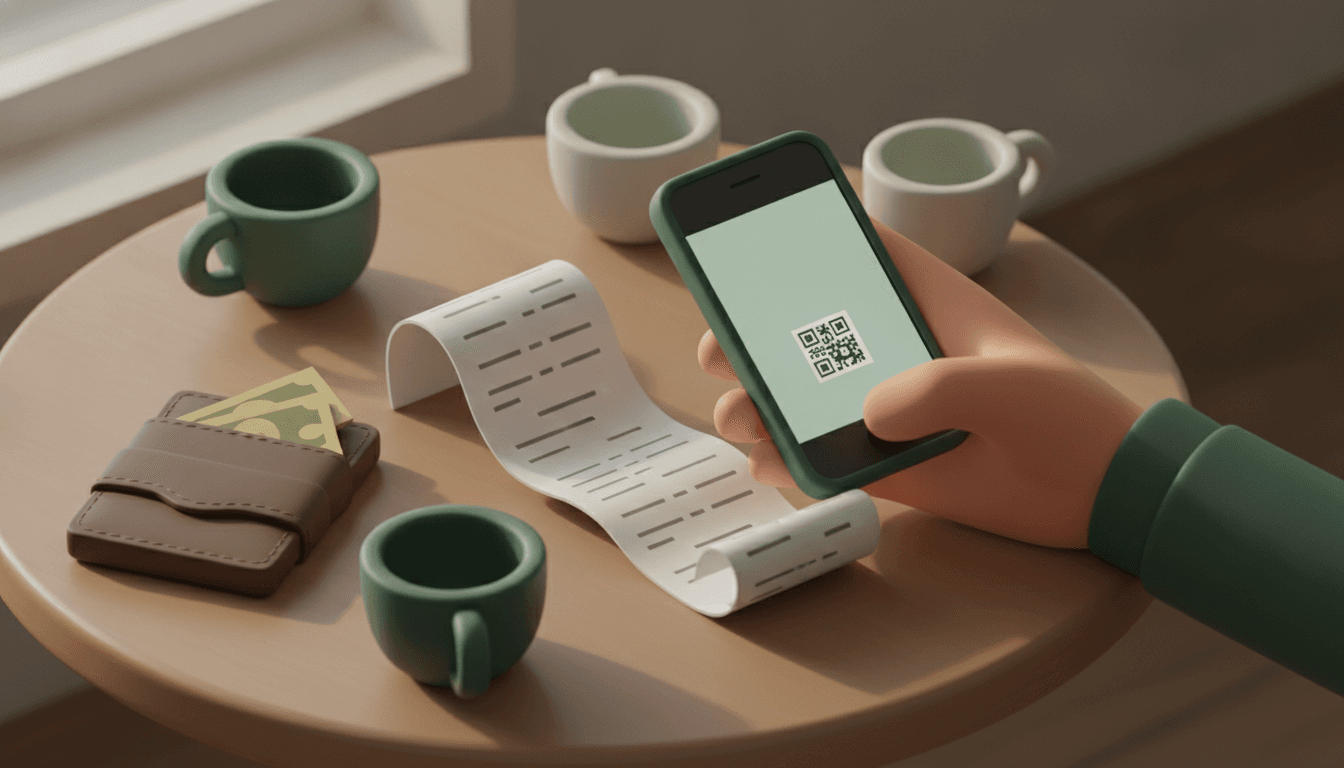
Receipt scanning and bill splitting means you take a photo of a paper receipt or scan a fiscal QR code, and the app automatically recognizes items, prices, and taxes, dividing the amount among the exact number of people—without manual addition and without an Excel spreadsheet. The result is a deterministic calculation, not an estimate.
This guide on receipt scanning and bill splitting is intended for apartment organizers, couples, travel groups, and anyone tired of punching receipts into a calculator. By the end of the text, you will know the difference between OCR and a fiscal QR code, how much it costs, and how to avoid the most common mistakes when scanning receipts and splitting bills.
Key takeaways
- A fiscal QR code extracts items, prices, and taxes directly from tax authority servers with a zero-margin error, while OCR receipt image scanning can misread faded thermal paper or unusual fonts.
- Splitwise limits its free plan to about 3 to 5 expense entries per day alongside nagging and ads, and OCR receipt scanning is locked behind a Splitwise Pro subscription costing about $50 per year.
- The debt simplification algorithm can reduce 10 to 15 cross-debts in a group of 6 to 8 people down to just 2 to 3 direct money transfers.
- Split The Bill enables bill sharing via link without app installation for everyone who just needs to see and pay their share.
- Local tools use e-fiscal QR codes to instantly pull item names, total amounts, and warranty dates directly from tax authority servers.
What does receipt scanning and bill splitting mean?
Receipt scanning and bill splitting is the process where a digital tool turns a physical or fiscal receipt into structured data—items, prices, taxes—and then automatically distributes the amount among the people who participated in the purchase. There are two technically different approaches, and mixing them up is a common source of confusion.
The first approach is OCR (optical character recognition), which reads a receipt photo line by line and tries to guess what it says. The second is reading a fiscal QR code, which does not "guess" anything—it retrieves the official, already digitized record directly from the tax authority server.
For the user, the difference is practical: OCR works on any receipt, including foreign and handwritten ones, but can make mistakes with poor printing. Fiscal QR works only on local fiscal receipts, but when it works, errors are practically eliminated.
What does the step-by-step receipt scanning and bill splitting process look like?
The process has five steps that together take less than a minute when the receipt is legible: taking a photo or scanning, item recognition, assigning items to people, calculation with taxes and tips, and sending the payment link. Here is the sequence used by serious bill splitting apps:
- Take a photo of the receipt or scan the fiscal QR code with your phone, directly from the app.
- The app recognizes items, prices, and taxes—through OCR if it is an image, or through the official record if it is a QR code.
- Mark who ordered what—assigning items per person, rather than just splitting the total amount into equal parts.
- The system calculates the exact amount per person, including proportional taxes and tips if applicable.
- Send a sharing link—others see their debt and can confirm or pay, without installation and without creating an account.
This sequence works identically for a restaurant dinner, a joint grocery shopping trip, or an electricity bill shared with roommates.
Fiscal QR code or OCR scanning: which is more accurate?
A fiscal QR code is more accurate whenever it is available, because it reads structured data directly from tax authority servers instead of interpreting an image. OCR remains necessary for receipts without a fiscal QR code—foreign restaurants, handwritten receipts, or old receipts.
| Criterion | Fiscal QR code | OCR image scanning |
|---|---|---|
| Data source | Official tax authority server | Receipt photograph |
| Accuracy of items and taxes | Practically error-free | Depends on image quality and font |
| Works on foreign receipts | No | Yes |
| Works on faded thermal paper | Yes (data is digital) | Often no |
| Processing speed | Instant | A few seconds, with confirmation |
For local receipts from supermarkets, restaurants, or pharmacies, the fiscal QR is always the better choice when supported by the app. For everything else, OCR is the only option and is still good enough to save time compared to manual typing.
How much does receipt scanning and bill splitting cost?
Price depends on whether scanning is included in the free plan or locked behind a subscription, and how many entries you are allowed to make per day. The differences between apps are larger than they appear at first glance.
Splitwise, for example, limits its free plan to about 3 to 5 expense entries per day with nagging and ads, and itemized OCR scanning is only available with a Splitwise Pro subscription costing about $50 per year. This is a significant difference if a group generates multiple receipts per week—travel, shared kitchen, roommates.
| App | Scanning in free plan | Fiscal QR code | Sharing without installation |
|---|---|---|---|
| Split The Bill | Yes, with reasonable limits | Yes | Yes, via link |
| Splitwise | Limited, OCR behind Pro plan | No | Limited |
| Local tools | Yes, focus on fiscal data | Yes | Depends on the tool |
For a more detailed analysis of pricing plans and hidden limitations, check out our article on how much expense sharing via app really costs, as well as an overview of how Splitwise works in 2026.
How to split expenses with roommates, a partner, and on trips?
The method of splitting depends on the type of expense: rent and utility bills require a recurring, fixed split, while a restaurant dinner or a travel kitty require itemized splitting. Mixing these two approaches is why groups often get stuck during calculations.
For roommates, the recurring expenses model works best—rent, electricity, internet—where the same percentage is automatically applied every month, with a reminder before the payment due date. For couples, it is similar, usually with a 50/50 split or proportioned by income.
For trips, the situation is more complex because expenses pile up quickly and often in multiple currencies—hotel in Euros, taxi in local currency, tickets in the host country's currency. Here, it is important that the app performs multi-currency calculations automatically, rather than having someone sit at the end of the trip with a calculator and an exchange rate list.
For groups that include people who are unwilling to install anything new, bill sharing via link without app installation solves the biggest source of friction—no one has to create an account to see how much they owe.
What are the most common mistakes when splitting bills and how to avoid them?
The most common mistake is splitting the total bill equally when people ordered different things at different prices—this systematically penalizes those who ordered less. Here are the most repeated mistakes and how to avoid them:
- Splitting "down the middle" regardless of items—instead, assign each item to the person who ordered it, and only then distribute shared costs (delivery, bread).
- Forgetting taxes and tips—if taxes and tips are not distributed proportionally, individual amounts will not match the total bill.
- Delaying debt settlement—the longer you wait, the harder it is for people to remember who paid for what; settling immediately after an outing is safest.
- Insisting everyone install the same app—this is the main reason groups give up on splitting expenses; the solution is a link that opens in a browser without an account.
- Manual addition instead of scanning the fiscal QR code—when available, the fiscal QR eliminates digit-typing errors.
Frequently asked questions
Is scanning a fiscal QR code more accurate than photographing a receipt?
Yes. A fiscal QR code downloads an already digitized, official record directly from the tax authority server, so errors are practically eliminated. Photographing a receipt relies on OCR which interprets the image and can fail on a faded thermal tape or unusual font.
Can I split expenses without everyone installing an app?
Yes, modern solutions send a sharing link that opens in any browser, without an account and without installation. Other group members see the exact amount they owe and can confirm or pay directly via that link.
Does receipt scanning work for foreign language receipts?
OCR image scanning usually works on foreign receipts as well, although accuracy is somewhat lower than for local fiscal receipts with a QR code. Fiscal QR codes are specific to the local e-fiscalization system and do not exist on receipts from other countries.
How long can I use the app for free before being asked for a subscription?
It depends on the app: Splitwise limits the free plan to about 3 to 5 entries per day and charges for itemized OCR scanning through a Pro subscription costing about $50 per year. Other apps, including local tools focused on fiscal data, offer broader free access to scanning.
How does the app calculate who owes whom?
The app tallies all entered expenses and applies a debt simplification algorithm that minimizes the number of transactions needed for settlement. In a group of 6 to 8 people, this can reduce 10 to 15 cross-debts to just 2 to 3 direct money transfers, instead of everyone paying everyone individually.
Try receipt scanning and bill splitting without installation
Next time someone in the group says "just send me what I owe," don't pull out a calculator. Snap a photo of the receipt or scan the fiscal QR code, let the math be deterministic, and send the link—without pressuring that one friend to download yet another app.
Split The Bill is built precisely for that moment: fast scanning, accurate splitting with taxes included, and sharing via link for everyone who doesn't want an account. No traps, no hidden limits for basic use—just the exact amount, fast.
Quick FAQ
Is scanning a fiscal QR code more accurate than photographing a receipt?
Yes. A fiscal QR code downloads an already digitized, official record directly from the tax authority server, so errors are practically eliminated. Photographing a receipt relies on OCR which interprets the image and can fail on a faded thermal tape or unusual font.
Can I split expenses without everyone installing an app?
Yes, modern solutions send a sharing link that opens in any browser, without an account and without installation. Other group members see the exact amount they owe and can confirm or pay directly via that link.
Does receipt scanning work for foreign language receipts?
OCR image scanning usually works on foreign receipts as well, although accuracy is somewhat lower than for local fiscal receipts with a QR code. Fiscal QR codes are specific to the local e-fiscalization system and do not exist on receipts from other countries.
How long can I use the app for free before being asked for a subscription?
It depends on the app: Splitwise limits the free plan to about 3 to 5 entries per day and charges for itemized OCR scanning through a Pro subscription costing about $50 per year. Other apps, including local tools focused on fiscal data, offer broader free access to scanning.
How does the app calculate who owes whom?
The app tallies all entered expenses and applies a debt simplification algorithm that minimizes the number of transactions needed for settlement. In a group of 6 to 8 people, this can reduce 10 to 15 cross-debts to just 2 to 3 direct money transfers, instead of everyone paying everyone individually.
Try Split The Bill — free
10 receipt-scanned bills/month, recurring expenses, multi-currency, and settle-up via Venmo / PayPal / Revolut.
Create a free accountRelated posts
Split a Bill by Receipt Photo: The 2026 Guide
Learn how to split a bill using a receipt photo or tax QR code without downloading an app. Step-by-step, app comparisons, and mistakes to avoid in 2026.
- Apps
- Splitting
- Bill

Split expenses without registration: A practical guide
Split expenses without registration: divide a bill in 30 seconds, no accounts or passwords needed. The best tools, steps, and tips for 2026.
- Aplikacija
- Deljenje
- Skeniranje

Splitting Bills Without Installing an App
Splitting bills without installation means paying via a browser link, with no app and no account. Here is how it works and the best tools for 2026.
- Aplikacija
- Splitting
- Bill


